


Page 442 - The ISA Handbook in Contemporary Sociology
P. 442
9781412934633-Chap-27  1/10/09  8:57 AM  Page 413


                                         THE DYNAMICS OF LOCAL-GLOBAL RELATIONS              413


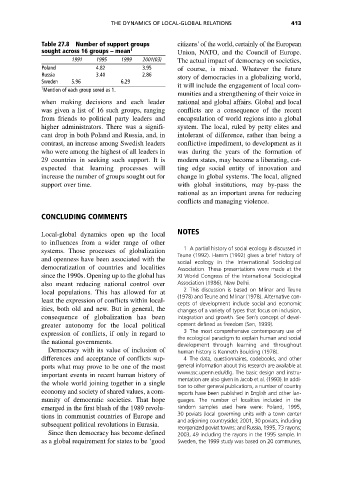
                    Table 27.8  Number of support groups    citizens’of the world, certainly of the European
                    sought across 16 groups – mean 1        Union, NATO, and the Council of Europe.
                             1991   1995   1999   2001(03)  The actual impact of democracy on societies,
                    Poland          4.82          3.95      of course, is mixed.  Whatever the future
                    Russia          3.40          2.86      story of democracies in a globalizing world,
                    Sweden   5.96          6.29
                                                            it will include the engagement of local com-
                    1 Mention of each group sored as 1.
                                                            munities and a strengthening of their voice in
                    when making decisions and each leader   national and global affairs. Global and local
                    was given a list of 16 such groups, ranging   conflicts are a consequence of the recent
                    from friends to political party leaders and  encapsulation of world regions into a global
                    higher administrators.  There was a signifi-  system. The local, ruled by petty elites and
                    cant drop in both Poland and Russia, and, in  intolerant of difference, rather than being a
                    contrast, an increase among Swedish leaders  conflictive impediment, to development as it
                    who were among the highest of all leaders in   was during the years of the formation of
                    29 countries in seeking such support. It is  modern states, may become a liberating, cut-
                    expected that learning processes will   ting edge social entity of innovation and
                    increase the number of groups sought out for  change in global systems. The local, aligned
                    support over time.                      with global institutions, may by-pass the
                                                            national as an important arena for reducing
                                                            conflicts and managing violence.

                    CONCLUDING COMMENTS

                    Local-global dynamics open up the local   NOTES
                    to influences from a wider range of other
                    systems.  Those processes of globalization  1 A partial history of social ecology is discussed in
                                                            Teune (1992). Hamm (1992) gives a brief history of
                    and openness have been associated with the
                                                            social ecology in the International Sociological
                    democratization of countries and localities  Association. These presentations were made at the
                    since the 1990s. Opening up to the global has  XI World Congress of the International Sociological
                    also meant reducing national control over  Association (1986), New Delhi.
                    local populations.  This has allowed for at  2 This discussion is based on Mlinar and Teune
                                                            (1978) and Teune and Mlinar (1978). Alternative con-
                    least the expression of conflicts within local-
                                                            cepts of development include social and economic
                    ities, both old and new. But in general, the  changes of a variety of types that focus on inclusion,
                    consequence of globalization has been   integration and growth. See Sen’s concept of devel-
                    greater autonomy for the local political  opment defined as freedom (Sen, 1999).
                    expression of conflicts, if only in regard to  3 The most comprehensive contemporary use of
                                                            the ecological paradigm to explain human and social
                    the national governments.
                                                            development through learning and throughout
                      Democracy with its value of inclusion of  human history is Kenneth Boulding (1978).
                    differences and acceptance of conflicts sup-  4 The data, questionnaires, codebooks, and other
                    ports what may prove to be one of the most  general information about this research are available at
                    important events in recent human history of  www.ssc.upenn.edu/dlg. The basic design and instru-
                                                            mentation are also given in Jacob et al. (1993). In addi-
                    the whole world joining together in a single
                                                            tion to other general publications, a number of country
                    economy and society of shared values, a com-  reports have been published in English and other lan-
                    munity of democratic societies.  That hope  guages. The number of localities included in the
                    emerged in the first blush of the 1989 revolu-  random samples used here were: Poland, 1995,
                    tions in communist countries of Europe and  30 poviats (local governing units with a town center
                                                            and adjoining countryside); 2001, 30 poviats, including
                    subsequent political revolutions in Eurasia.
                                                            reorganized poviat towns; and Russia, 1995, 73 rayons;
                      Since then democracy has become defined  2003, 49 including the rayons in the 1995 sample. In
                    as a global requirement for states to be ‘good  Sweden, the 1999 study was based on 20 communes,

