


Page 441 - The ISA Handbook in Contemporary Sociology
P. 441
9781412934633-Chap-27  1/10/09  8:57 AM  Page 412


                   412               THE ISA HANDBOOK IN CONTEMPORARY SOCIOLOGY


                   Table 27.4  Having local autonomy: mean 1  Table 27.6  Local priorities vs. national
                              1995     1999     2001(03)   priorities – mean score 1
                   Poland     0.56              0.56                1991   1995   1999   2001(03)
                   Russia     0.56              0.58       Poland          0.17          0.11
                   Sweden              0.65                Russia          0.29          0.32
                   1 ’Have local antonomy’ = 1, asked about 13 policy areas,  Sweden  0.13  0.15
                   including education, employment, pollution, housing, etc.  1 Answer options: ‘agree’ or ‘disagree’; positive = local.
                   Note: Not asked in Sweden in 1991.
                   years of a re-centralization. In Poland local  leaders became less, although still relatively
                   leaders perceived a drop in autonomy, most  highly oriented to the local, and the Russian
                   probably because there was an increase of  leaders slightly more focused on the local,
                   central authority over the provincial level of  with no change among the Swedish leaders
                   government with the appointment of, rather  even though Sweden was in the process of
                   than previous election of ‘governors’.  loosening central governmental control
                     Using a three-point scale, a general ques-  throughout this period.
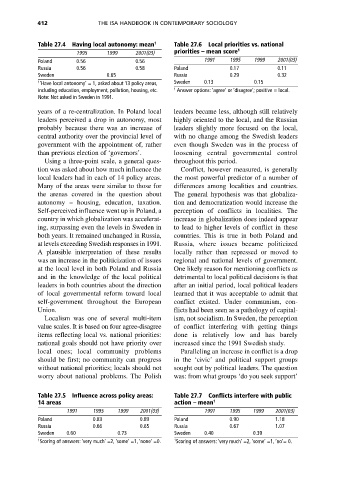
                   tion was asked about how much influence the  Conflict, however measured, is generally
                   local leaders had in each of 14 policy areas.  the most powerful predictor of a number of
                   Many of the areas were similar to those for  differences among localities and countries.
                   the arenas covered in the question about  The general hypothesis was that globaliza-
                   autonomy – housing, education, taxation.  tion and democratization would increase the
                   Self-perceived influence went up in Poland, a  perception of conflicts in localities.  The
                   country in which globalization was accelerat-  increase in globalization does indeed appear
                   ing, surpassing even the levels in Sweden in  to lead to higher levels of conflict in these
                   both years. It remained unchanged in Russia,  countries.  This is true in both Poland and
                   at levels exceeding Swedish responses in 1991.  Russia, where issues became politicized
                   A plausible interpretation of these results  locally rather than repressed or moved to
                   was an increase in the politicization of issues  regional and national levels of government.
                   at the local level in both Poland and Russia  One likely reason for mentioning conflicts as
                   and in the knowledge of the local political  detrimental to local political decisions is that
                   leaders in both countries about the direction  after an initial period, local political leaders
                   of local governmental reform toward local  learned that it was acceptable to admit that
                   self-government throughout the European  conflict existed. Under communism, con-
                   Union.                                  flicts had been seen as a pathology of capital-
                     Localism was one of several multi-item  ism, not socialism. In Sweden, the perception
                   value scales. It is based on four agree-disagree  of conflict interfering with getting things
                   items reflecting local vs. national priorities:  done is relatively low and has barely
                   national goals should not have priority over  increased since the 1991 Swedish study.
                   local ones; local community problems      Paralleling an increase in conflict is a drop
                   should be first; no community can progress  in the ‘civic’ and political support groups
                   without national priorities; locals should not  sought out by political leaders. The question
                   worry about national problems.  The Polish  was: from what groups ‘do you seek support’


                   Table 27.5  Influence across policy areas:  Table 27.7  Conflicts interfere with public
                   14 areas                                action – mean 1
                            1991   1995   1999   2001(03)           1991   1995   1999  2001(03)
                   Poland          0.83          0.89      Poland          0.90         1.18
                   Russia          0.66          0.65      Russia          0.67         1.07
                   Sweden   0.60          0.73             Sweden   0.40          0.39
                   1 Scoring of answers: ‘very much’ =2, ‘some’ =1, ‘none’ =0.  1 Scoring of answers: ‘very much’ =2, ‘some’ =1, ‘no’= 0.

