


Page 440 - The ISA Handbook in Contemporary Sociology
P. 440
9781412934633-Chap-27  1/10/09  8:57 AM  Page 411


                                         THE DYNAMICS OF LOCAL-GLOBAL RELATIONS              411


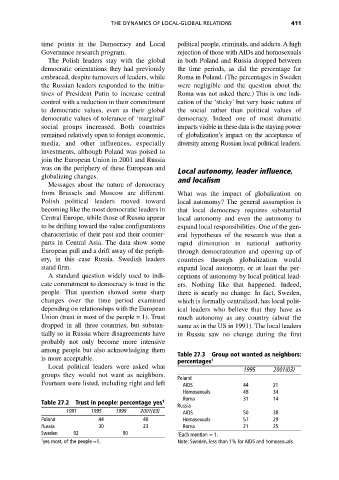
                    time points in the Democracy and Local  political people, criminals, and addicts. A high
                    Governance research program.            rejection of those with AIDs and homosexuals
                      The Polish leaders stay with the global  in both Poland and Russia dropped between
                    democratic orientations they had previously  the time periods, as did the percentage for
                    embraced, despite turnovers of leaders, while  Roma in Poland. (The percentages in Sweden
                    the Russian leaders responded to the initia-  were negligible and the question about the
                    tives of President Putin to increase central  Roma was not asked there.) This is one indi-
                    control with a reduction in their commitment  cation of the ‘sticky’ but very basic nature of
                    to democratic values, even as their global  the social rather than political values of
                    democratic values of tolerance of ‘marginal’  democracy. Indeed one of most dramatic
                    social groups increased. Both countries  impacts visible in these data is the staying power
                    remained relatively open to foreign economic,  of globalization’s impact on the acceptance of
                    media, and other influences, especially  diversity among Russian local political leaders.
                    investments, although Poland was poised to
                    join the European Union in 2001 and Russia
                    was on the periphery of these European and  Local autonomy, leader influence,
                    globalizing changes.                    and localism
                      Messages about the nature of democracy
                    from Brussels and Moscow are different.  What was the impact of globalization on
                    Polish political leaders moved toward   local autonomy? The general assumption is
                    becoming like the most democratic leaders in  that local democracy requires substantial
                    Central Europe, while those of Russia appear  local autonomy and even the autonomy to
                    to be drifting toward the value configurations  expand local responsibilities. One of the gen-
                    characteristic of their past and their counter-  eral hypotheses of the research was that a
                    parts in Central Asia. The data show some  rapid diminution in national authority
                    European pull and a drift away of the periph-  through democratization and opening up of
                    ery, in this case Russia. Swedish leaders  countries through globalization would
                    stand firm.                             expand local autonomy, or at least the per-
                      A standard question widely used to indi-  ceptions of autonomy by local political lead-
                    cate commitment to democracy is trust in the  ers. Nothing like that happened. Indeed,
                    people.  That question showed some sharp  there is nearly no change. In fact, Sweden,
                    changes over the time period examined   which is formally centralized, has local polit-
                    depending on relationships with the European  ical leaders who believe that they have as
                    Union (trust in most of the people = 1). Trust  much autonomy as any country (about the
                    dropped in all three countries, but substan-  same as in the US in 1991). The local leaders
                    tially so in Russia where disagreements have  in Russia saw no change during the first
                    probably not only become more intensive
                    among people but also acknowledging them
                                                            Table 27.3  Group not wanted as neighbors:
                    is more acceptable.                               1
                                                            percentages
                      Local political leaders were asked what
                                                                               1995     2001(03)
                    groups they would not want as neighbors.
                                                            Poland
                    Fourteen were listed, including right and left  AIDS       44       21
                                                             Homosexuals       48       34
                                                             Roma              31       14
                    Table 27.2  Trust in people: percentage yes 1
                                                            Russia
                           1991    1995   1999   2001(03)    AIDS              50       38
                    Poland           44           40         Homosexuals       57       29
                    Russia           30           23         Roma              21       25
                    Sweden    92            90              1 Each mention = 1.
                    1 yes most, of the people =1.           Note: Sweden, less than 1% for AIDS and homosexuals.

