


Page 371 - ARM 64 Bit Assembly Language
P. 371
Advanced SIMD instructions 361

                     10.6.9.1 Syntax

                          (s|u)qadd        Fd, Fn, Fm
                          (s|u)qsub        Fd, Fn, Fm
                          sq{r}dmulh       <Fx>d, <Fx>n, <Fx>m
                          (s|u)q{r}shl     Fd, Fn, Fm


                     •   F is b, h, sd.
                     •   <Fx> is h or s.

                     10.6.9.2 Operations

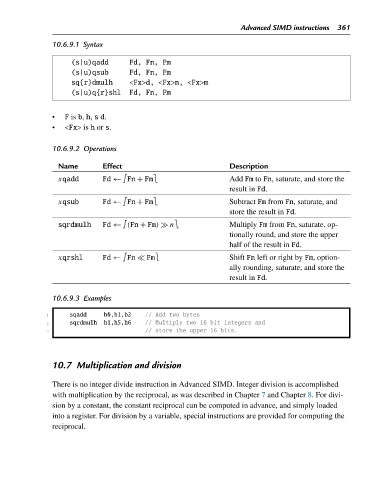
                       Name        Effect                             Description

                       xqadd       Fd ← Fn + Fm                       Add Fm to Fn, saturate, and store the
                                                                      result in Fd.
                       xqsub       Fd ← Fn + Fm                       Subtract Fm from Fn, saturate, and
                                                                      store the result in Fd.
                       sqrdmulh    Fd ← (Fn + Fm)   n                 Multiply Fm from Fn, saturate, op-
                                                                      tionally round, and store the upper
                                                                      half of the result in Fd.
                       xqrshl      Fd ← Fn   Fm                       Shift Fn left or right by Fm, option-
                                                                      ally rounding, saturate, and store the
                                                                      result in Fd.


                     10.6.9.3 Examples

                    1     sqadd     b0,b1,b2   // Add two bytes
                    2     sqrdmulh  h1,h5,h6   // Multiply two 16 bit integers and
                    3                          // store the upper 16 bits.


                     10.7 Multiplication and division

                     There is no integer divide instruction in Advanced SIMD. Integer division is accomplished
                     with multiplication by the reciprocal, as was described in Chapter 7 and Chapter 8. For divi-
                     sion by a constant, the constant reciprocal can be computed in advance, and simply loaded
                     into a register. For division by a variable, special instructions are provided for computing the
                     reciprocal.

