


Page 476 - Advanced Design Examples of Seismic Retrofit of Structures
P. 476
Examples of Nonengineered Buildings Chapter  6 419


             walls but still allowed displacements of the blocks. Stiffer straps may have been
             used to provide greater restraint against damage, but two factors would need to
             be taken into account: (1) a failure plane might develop just above the strap that
             would permit slippage; or (2) the strap may dig into the adobe material and
             loosen, even with a stiffer strap. To try to control the latter, a wire-mesh screen
             was added at the exposed corners. However, the straps were still able to dig
             into the adobe at the through-wall holes. Minimal damage was observed in
             the in-plane wall of Model 9, where the vertical center-core rods were used
             (Fig. 6.21D) [5].
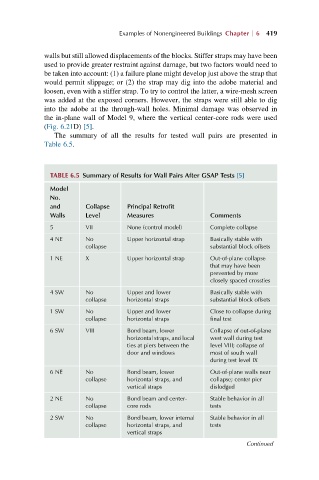
                The summary of all the results for tested wall pairs are presented in
             Table 6.5.


               TABLE 6.5 Summary of Results for Wall Pairs After GSAP Tests [5]
               Model
               No.
               and      Collapse   Principal Retrofit
               Walls    Level      Measures               Comments
               5        VII        None (control model)   Complete collapse
               4NE      No         Upper horizontal strap  Basically stable with
                        collapse                          substantial block offsets
               1 NE     X          Upper horizontal strap  Out-of-plane collapse
                                                          that may have been
                                                          prevented by more
                                                          closely spaced crossties
               4SW      No         Upper and lower        Basically stable with
                        collapse   horizontal straps      substantial block offsets
               1SW      No         Upper and lower        Close to collapse during
                        collapse   horizontal straps      final test
               6 SW     VIII       Bond beam, lower       Collapse of out-of-plane
                                   horizontal straps, and local  west wall during test
                                   ties at piers between the  level VIII; collapse of
                                   door and windows       most of south wall
                                                          during test level IX
               6NE      No         Bond beam, lower       Out-of-plane walls near
                        collapse   horizontal straps, and  collapse; center pier
                                   vertical straps        dislodged
               2NE      No         Bond beam and center-  Stable behavior in all
                        collapse   core rods              tests
               2SW      No         Bond beam, lower internal  Stable behavior in all
                        collapse   horizontal straps, and  tests
                                   vertical straps
                                                                    Continued

