


Page 591 - Advanced_Engineering_Mathematics o'neil
P. 591
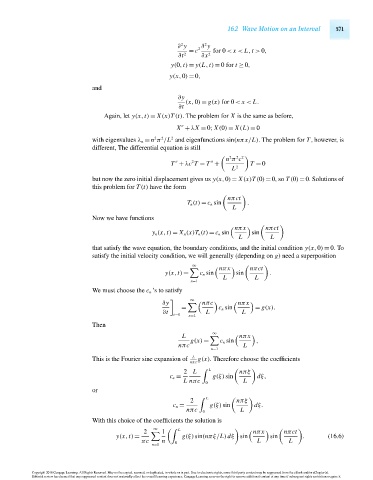
16.2 Wave Motion on an Interval  571


                                                                   2
                                                                          2
                                                                  ∂ y    ∂ y
                                                                     = c 2   for 0 < x < L,t > 0,
                                                                  ∂t  2  ∂x  2
                                                                y(0,t) = y(L,t) = 0for t ≥ 0,
                                                               y(x,0) = 0,
                                        and
                                                                  ∂y
                                                                    (x,0) = g(x) for 0 < x < L.
                                                                  ∂t
                                           Again, let y(x,t) = X(x)T (t). The problem for X is the same as before,

                                                                  X + λX = 0; X(0) = X(L) = 0
                                                             2
                                                           2
                                        with eigenvalues λ n = n π /L and eigenfunctions sin(nπx/L). The problem for T , however, is
                                                                2
                                        different, The differential equation is still
                                                                                n π c
                                                                                  2  2 2
                                                                      2
                                                                T + λc T = T +          T = 0
                                                                                  L 2
                                        but now the zero initial displacement gives us y(x,0) = X(x)T (0) = 0, so T (0) =0. Solutions of
                                        this problem for T (t) have the form

                                                                                 nπct
                                                                     T n (t) = c n sin  .
                                                                                   L
                                        Now we have functions
                                                                                   nπx       nπct

                                                          y n (x,t) = X n (x)T n (t) = c n sin  sin
                                                                                    L         L
                                        that satisfy the wave equation, the boundary conditions, and the initial condition y(x,0) = 0. To
                                        satisfy the initial velocity condition, we will generally (depending on g) need a superposition
                                                                      ∞


        nπx       nπct
                                                              y(x,t) =   c n sin    sin       .
                                                                                L        L
                                                                      n=1
                                        We must choose the c n ’s to satisfy
                                                             ∂y
   nπc         nπx
                                                                      ∞
                                                                   =          c n sin    = g(x).
                                                             ∂t           L          L
                                                                 t=0  n=1
                                        Then
                                                                            ∞
                                                                   L
        nπx
                                                                      g(x) =   c n sin    ,
                                                                  nπc                 L
                                                                            n=1
                                        This is the Fourier sine expansion of  L  g(x). Therefore choose the coefficients
                                                                      nπc
                                                                    2 L     L        nπξ
                                                               c n =        g(ξ)sin       dξ,
                                                                    L nπc  0          L
                                        or
                                                                      2     L        nπξ
                                                                c n =       g(ξ)sin      dξ.
                                                                    nπc  0           L
                                        With this choice of the coefficients the solution is
                                                          ∞
                                                        2
  1      L                   nπx       nπct
                                               y(x,t) =            g(ξ)sin(nπξ/L)dξ sin       sin       .       (16.6)
                                                       πc    n   0                        L         L
                                                          n=1


                      Copyright 2010 Cengage Learning. All Rights Reserved. May not be copied, scanned, or duplicated, in whole or in part. Due to electronic rights, some third party content may be suppressed from the eBook and/or eChapter(s).
                      Editorial review has deemed that any suppressed content does not materially affect the overall learning experience. Cengage Learning reserves the right to remove additional content at any time if subsequent rights restrictions require it.

                                   October 14, 2010  15:23  THM/NEIL   Page-571        27410_16_ch16_p563-610

