


Page 430 - Air Pollution Control Engineering
P. 430
10_chap_wang.qxd  05/05/2004  5:10 pm  Page 402
                    402                                                    Lawrence K.Wang et al.

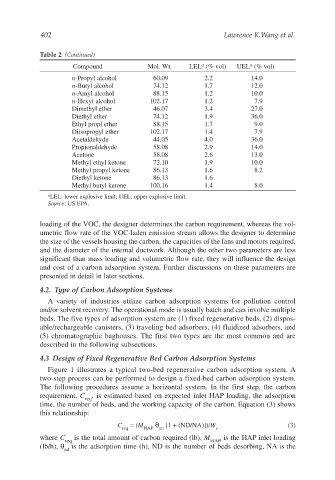
                    Table 2 (Continued)
                                                                     a
                                                                                   a
                              Compound               Mol. Wt.    LEL (% vol)   UEL (% vol)
                              n-Propyl alcohol        60.09           2.2           14.0
                              n-Butyl alcohol         74.12           1.7           12.0
                              n-Amyl alcohol          88.15           1.2           10.0
                              n-Hexyl alcohol        102.17           1.2            7.9
                              Dimethyl ether          46.07           3.4           27.0
                              Diethyl ether           74.12           1.9           36.0
                              Ethyl propl ether       88.15           1.7            9.0
                              Diisopropyl ether      102.17           1.4            7.9
                              Acetaldehyde            44.05           4.0           36.0
                              Propionaldehyde         58.08           2.9           14.0
                              Acetone                 58.08           2.6           13.0
                              Methyl ethyl ketone     72.10           1.9           10.0
                              Methyl propyl ketone    86.13           1.6            8.2
                              Diethyl ketone          86.13           1.6
                              Methyl butyl ketone    100.16           1.4            8.0
                       a LEL: lower explosive limit; UEL: upper explosive limit.
                       Source: US EPA.


                    loading of the VOC, the designer determines the carbon requirement, whereas the vol-
                    umetric flow rate of the VOC-laden emission stream allows the designer to determine
                    the size of the vessels housing the carbon, the capacities of the fans and motors required,
                    and the diameter of the internal ductwork. Although the other two parameters are less
                    significant than mass loading and volumetric flow rate, they will influence the design
                    and cost of a carbon adsorption system. Further discussions on these parameters are
                    presented in detail in later sections.
                    4.2. Type of Carbon Adsorption Systems

                       A variety of industries utilize carbon adsorption systems for pollution control
                    and/or solvent recovery. The operational mode is usually batch and can involve multiple
                    beds. The five types of adsorption system are (1) fixed regenerative beds, (2) dispos-
                    able/rechargeable canisters, (3) traveling bed adsorbers, (4) fluidized adsorbers, and
                    (5) chromatographic baghouses. The first two types are the most common and are
                    described in the following subsections.
                    4.3 Design of Fixed Regenerative Bed Carbon Adsorption Systems
                       Figure 1 illustrates a typical two-bed regenerative carbon adsorption system. A
                    two-step process can be performed to design a fixed-bed carbon adsorption system.
                    The  following procedures assume a horizontal system. In the first step, the carbon
                    requirement, C , is estimated based on expected inlet HAP loading, the adsorption
                                  req
                    time, the number of beds, and the working capacity of the carbon. Equation (3) shows
                    this relationship:

                                            C  = (M    θ [1 + (ND/NA)])/W                      (3)
                                             req   HAP  ad               c
                    where C    is the total amount of carbon required (lb), M  is the HAP inlet loading
                            req                                        HAP
                    (lb/h), θ is the adsorption time (h), ND is the number of beds desorbing, NA is the
                            ad

