


Page 322 -
P. 322
296   Chapter 8 ■ Classification


                           values, or a small standard deviation, is desired because it corresponds to an
                           easier thresholding problem. It would also mean that the feature values would
                           be less likely to overlap with those of other objects. A large distance between
                           means of classes to be separated is important, too.
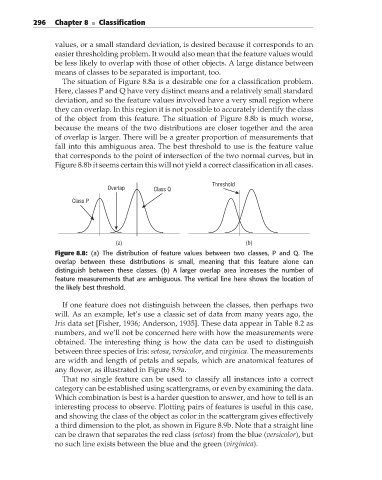
                             The situation of Figure 8.8a is a desirable one for a classification problem.
                           Here, classes P and Q have very distinct means and a relatively small standard
                           deviation, and so the feature values involved have a very small region where
                           they can overlap. In this region it is not possible to accurately identify the class
                           of the object from this feature. The situation of Figure 8.8b is much worse,
                           because the means of the two distributions are closer together and the area
                           of overlap is larger. There will be a greater proportion of measurements that
                           fall into this ambiguous area. The best threshold to use is the feature value
                           that corresponds to the point of intersection of the two normal curves, but in
                           Figure 8.8b it seems certain this will not yield a correct classification in all cases.

                                                                       Threshold
                                          Overlap     Class Q
                                Class P


                                            (a)                                 (b)
                           Figure 8.8: (a) The distribution of feature values between two classes, P and Q. The
                           overlap between these distributions is small, meaning that this feature alone can
                           distinguish between these classes. (b) A larger overlap area increases the number of
                           feature measurements that are ambiguous. The vertical line here shows the location of
                           the likely best threshold.

                             If one feature does not distinguish between the classes, then perhaps two
                           will. As an example, let’s use a classic set of data from many years ago, the
                           Iris data set [Fisher, 1936; Anderson, 1935]. These data appear in Table 8.2 as
                           numbers, and we’ll not be concerned here with how the measurements were
                           obtained. The interesting thing is how the data can be used to distinguish
                           between three species of Iris: setosa, versicolor,and virginica. The measurements
                           are width and length of petals and sepals, which are anatomical features of
                           any flower, as illustrated in Figure 8.9a.
                             That no single feature can be used to classify all instances into a correct
                           category can be established using scattergrams, or even by examining the data.
                           Which combination is best is a harder question to answer, and how to tell is an
                           interesting process to observe. Plotting pairs of features is useful in this case,
                           and showing the class of the object as color in the scattergram gives effectively
                           a third dimension to the plot, as shown in Figure 8.9b. Note that a straight line
                           can be drawn that separates the red class (setosa)from the blue (versicolor), but
                           no such line exists between the blue and the green (virginica).

