


Page 325 -
P. 325
Chapter 8 ■ Classification  299


                                               (a)                                   (b)
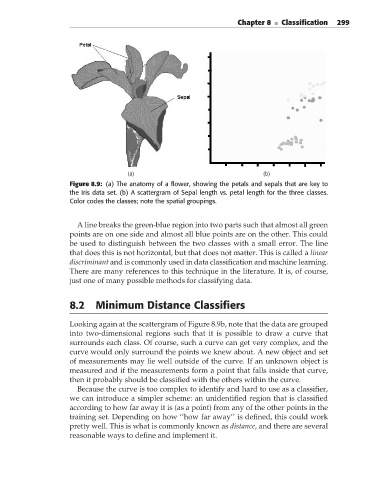
                               Figure 8.9: (a) The anatomy of a flower, showing the petals and sepals that are key to
                               the Iris data set. (b) A scattergram of Sepal length vs. petal length for the three classes.
                               Color codes the classes; note the spatial groupings.


                                 A line breaks the green-blue region into two parts such that almost all green
                               points are on one side and almost all blue points are on the other. This could
                               be used to distinguish between the two classes with a small error. The line
                               that does this is not horizontal, but that does not matter. This is called a linear
                               discriminant and is commonly used in data classification and machine learning.
                               There are many references to this technique in the literature. It is, of course,
                               just one of many possible methods for classifying data.


                               8.2 Minimum Distance Classifiers

                               Looking again at the scattergram of Figure 8.9b, note that the data are grouped
                               into two-dimensional regions such that it is possible to draw a curve that
                               surrounds each class. Of course, such a curve can get very complex, and the
                               curve would only surround the points we knew about. A new object and set
                               of measurements may lie well outside of the curve. If an unknown object is
                               measured and if the measurements form a point that falls inside that curve,
                               then it probably should be classified with the others within the curve.
                                 Because the curve is too complex to identify and hard to use as a classifier,
                               we can introduce a simpler scheme: an unidentified region that is classified
                               according to how far away it is (as a point) from any of the other points in the
                               training set. Depending on how ‘‘how far away’’ is defined, this could work
                               pretty well. This is what is commonly known as distance, and there are several
                               reasonable ways to define and implement it.

