


Page 449 -
P. 449
SINGLE-PERIOD INVENTORY MODEL WITH PROBABILISTIC DEMAND  429


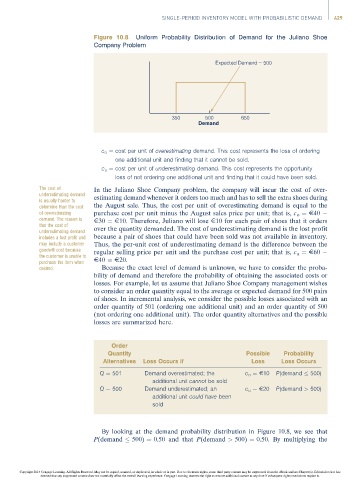
                                      Figure 10.8  Uniform Probability Distribution of Demand for the Juliano Shoe
                                      Company Problem

                                                                            Expected Demand = 500


                                                              350        500        650
                                                                      Demand


                                         c o ¼ cost per unit of overestimating demand: This cost represents the loss of ordering
                                             one additional unit and finding that it cannot be sold:
                                         c u ¼ cost per unit of underestimating demand: This cost represents the opportunity
                                             loss of not ordering one additional unit and finding that it could have been sold:
                      The cost of     In the Juliano Shoe Company problem, the company will incur the cost of over-
                      underestimating demand
                      is usually harder to  estimating demand whenever it orders too much and has to sell the extra shoes during
                      determine than the cost  the August sale. Thus, the cost per unit of overestimating demand is equal to the
                      of overestimating  purchase cost per unit minus the August sales price per unit; that is, c o ¼ E40
                      demand. The reason is  E30 ¼ E10. Therefore, Juliano will lose E10 for each pair of shoes that it orders
                      that the cost of
                      underestimating demand  over the quantity demanded. The cost of underestimating demand is the lost profit
                      includes a lost profit and  because a pair of shoes that could have been sold was not available in inventory.
                      may include a customer  Thus, the per-unit cost of underestimating demand is the difference between the
                      goodwill cost because  regular selling price per unit and the purchase cost per unit; that is, c u ¼ E60
                      the customer is unable to
                      purchase the item when  E40 ¼ E20.
                      desired.           Because the exact level of demand is unknown, we have to consider the proba-
                                      bility of demand and therefore the probability of obtaining the associated costs or
                                      losses. For example, let us assume that Juliano Shoe Company management wishes
                                      to consider an order quantity equal to the average or expected demand for 500 pairs
                                      of shoes. In incremental analysis, we consider the possible losses associated with an
                                      order quantity of 501 (ordering one additional unit) and an order quantity of 500
                                      (not ordering one additional unit). The order quantity alternatives and the possible
                                      losses are summarized here.


                                            Order
                                           Quantity                                  Possible    Probability
                                         Alternatives  Loss Occurs if                  Loss     Loss Occurs
                                        Q ¼ 501       Demand overestimated; the      c o ¼ E10  P(demand   500)
                                                        additional unit cannot be sold
                                        Q ¼ 500       Demand underestimated; an      c u ¼ E20  P(demand > 500)
                                                        additional unit could have been
                                                        sold


                                         By looking at the demand probability distribution in Figure 10.8, we see that
                                      P(demand   500) ¼ 0.50 and that P(demand > 500) ¼ 0.50. By multiplying the


                Copyright 2014 Cengage Learning. All Rights Reserved. May not be copied, scanned, or duplicated, in whole or in part. Due to electronic rights, some third party content may be suppressed from the eBook and/or eChapter(s). Editorial review has
                      deemed that any suppressed content does not materially affect the overall learning experience. Cengage Learning reserves the right to remove additional content at any time if subsequent rights restrictions require it.

