


Page 594 -
P. 594
574   CHAPTER 13 DECISION ANALYSIS


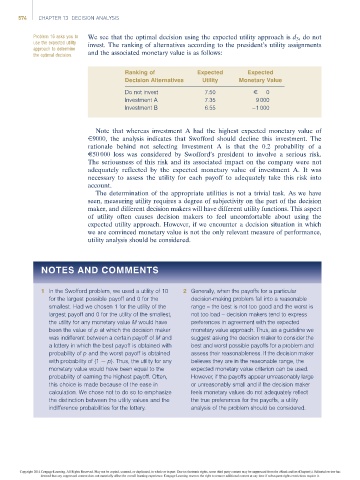
                    Problem 16 asks you to  We see that the optimal decision using the expected utility approach is d 3 , do not
                    use the expected utility  invest. The ranking of alternatives according to the president’s utility assignments
                    approach to determine
                    the optimal decision.  and the associated monetary value is as follows:

                                                Ranking of            Expected        Expected
                                                Decision Alternatives   Utility    Monetary Value

                                                Do not invest           7.50           E   0
                                                Investment A            7.35            9 000
                                                Investment B            6.55            1 000


                                       Note that whereas investment A had the highest expected monetary value of
                                     E9000, the analysis indicates that Swofford should decline this investment. The
                                     rationale behind not selecting Investment A is that the 0.2 probability of a
                                     E50 000 loss was considered by Swofford’s president to involve a serious risk.
                                     The seriousness of this risk and its associated impact on the company were not
                                     adequately reflected by the expected monetary value of investment A. It was
                                     necessary to assess the utility for each payoff to adequately take this risk into
                                     account.
                                       The determination of the appropriate utilities is not a trivial task. As we have
                                     seen, measuring utility requires a degree of subjectivity on the part of the decision
                                     maker, and different decision makers will have different utility functions. This aspect
                                     of utility often causes decision makers to feel uncomfortable about using the
                                     expected utility approach. However, if we encounter a decision situation in which
                                     we are convinced monetary value is not the only relevant measure of performance,
                                     utility analysis should be considered.


                      NOTES AND COMMENTS


                      1 In the Swofford problem, we used a utility of 10  2 Generally, when the payoffs for a particular
                         for the largest possible payoff and 0 for the  decision-making problem fall into a reasonable
                         smallest. Had we chosen 1 for the utility of the  range – the best is not too good and the worst is
                         largest payoff and 0 for the utility of the smallest,  not too bad – decision makers tend to express
                         the utility for any monetary value M would have  preferences in agreement with the expected
                         been the value of p at which the decision maker  monetary value approach. Thus, as a guideline we
                         was indifferent between a certain payoff of M and  suggest asking the decision maker to consider the
                         a lottery in which the best payoff is obtained with  best and worst possible payoffs for a problem and
                         probability of p and the worst payoff is obtained  assess their reasonableness. If the decision maker
                         with probability of (1   p). Thus, the utility for any  believes they are in the reasonable range, the
                         monetary value would have been equal to the  expected monetary value criterion can be used.
                         probability of earning the highest payoff. Often,  However, if the payoffs appear unreasonably large
                         this choice is made because of the ease in  or unreasonably small and if the decision maker
                         calculation. We chose not to do so to emphasize  feels monetary values do not adequately reflect
                         the distinction between the utility values and the  the true preferences for the payoffs, a utility
                         indifference probabilities for the lottery.  analysis of the problem should be considered.


                Copyright 2014 Cengage Learning. All Rights Reserved. May not be copied, scanned, or duplicated, in whole or in part. Due to electronic rights, some third party content may be suppressed from the eBook and/or eChapter(s). Editorial review has
                      deemed that any suppressed content does not materially affect the overall learning experience. Cengage Learning reserves the right to remove additional content at any time if subsequent rights restrictions require it.

