


Page 598 -
P. 598
578   CHAPTER 13 DECISION ANALYSIS


                                    a. Construct a decision tree for this problem.
                                    b. If the decision maker knows nothing about the probabilities of the three states of nature,
                                      what is the recommended decision using the optimistic, conservative and minimax
                                      regret approaches?

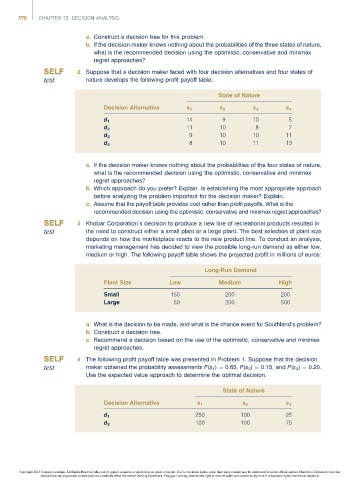
                                 2 Suppose that a decision maker faced with four decision alternatives and four states of
                                    nature develops the following profit payoff table.

                                                                             State of Nature

                                         Decision Alternative      s 1       s 2       s 3       s 4
                                         d 1                       14         9        10         5
                                         d 2                       11        10         8         7
                                         d 3                        9        10        10        11
                                         d 4                        8        10        11        13


                                    a. If the decision maker knows nothing about the probabilities of the four states of nature,
                                      what is the recommended decision using the optimistic, conservative and minimax
                                      regret approaches?
                                    b. Which approach do you prefer? Explain. Is establishing the most appropriate approach
                                      before analyzing the problem important for the decision maker? Explain.
                                    c. Assume that the payoff table provides cost rather than profit payoffs. What is the
                                      recommended decision using the optimistic, conservative and minimax regret approaches?
                                 3 Khobar Corporation’s decision to produce a new line of recreational products resulted in
                                    the need to construct either a small plant or a large plant. The best selection of plant size
                                    depends on how the marketplace reacts to the new product line. To conduct an analysis,
                                    marketing management has decided to view the possible long-run demand as either low,
                                    medium or high. The following payoff table shows the projected profit in millions of euros:

                                                                        Long-Run Demand
                                         Plant Size           Low            Medium            High
                                         Small                150              200              200
                                         Large                 50              200              500


                                    a. What is the decision to be made, and what is the chance event for Southland’s problem?
                                    b. Construct a decision tree.
                                    c. Recommend a decision based on the use of the optimistic, conservative and minimax
                                      regret approaches.
                                 4 The following profit payoff table was presented in Problem 1. Suppose that the decision
                                    maker obtained the probability assessments P(s 1 ) ¼ 0.65, P(s 2 ) ¼ 0.15, and P(s 3 ) ¼ 0.20.
                                    Use the expected value approach to determine the optimal decision.

                                                                              State of Nature
                                         Decision Alternative         s 1           s 2          s 3
                                                                      250          100           25
                                         d 1
                                                                      100          100           75
                                         d 2


                Copyright 2014 Cengage Learning. All Rights Reserved. May not be copied, scanned, or duplicated, in whole or in part. Due to electronic rights, some third party content may be suppressed from the eBook and/or eChapter(s). Editorial review has
                      deemed that any suppressed content does not materially affect the overall learning experience. Cengage Learning reserves the right to remove additional content at any time if subsequent rights restrictions require it.

