


Page 600 -
P. 600
580   CHAPTER 13 DECISION ANALYSIS


                                    a. What is the decision to be made, what is the chance event, and what is the
                                      consequence for this problem? How many decision alternatives are there? How many
                                      outcomes are there for the chance event?
                                    b. If nothing is known about the probabilities of the chance outcomes, what is the
                                      recommended decision using the optimistic, conservative and minimax regret
                                      approaches?
                                    c. Suppose that management of Scot Air Express believes that the probability of strong
                                      demand is 0.7 and the probability of weak demand is 0.3. Use the expected value
                                      approach to determine an optimal decision.
                                    d. Suppose that the probability of strong demand is 0.8 and the probability of weak
                                      demand is 0.2. What is the optimal decision using the expected value approach?
                                    e. Use graphical sensitivity analysis to determine the range of demand probabilities for
                                      which each of the decision alternatives has the largest expected value.
                                 8 For the PDC problem in Section 13.3, the decision alternative to build the large complex
                                    was found to be optimal using the expected value approach. In Section 13.4 we conducted
                                    a sensitivity analysis for the payoffs associated with this decision alternative. We found that
                                    the large complex remained optimal as long as the payoff for the strong demand was
                                    greater than or equal to R17.5 million and as long as the payoff for the weak demand was
                                    greater than or equal to  R19 million.
                                    a. Consider the medium complex decision. How much could the payoff under strong
                                      demand increase and still keep decision alternative d 3 the optimal solution?
                                    b. Consider the small complex decision. How much could the payoff under strong demand
                                      increase and still keep decision alternative d 3 the optimal solution?
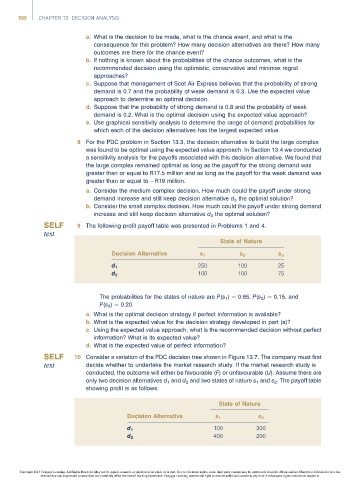
                                 9 The following profit payoff table was presented in Problems 1 and 4.

                                                                             State of Nature

                                            Decision Alternative       s 1         s 2         s 3
                                                                      250          100         25
                                            d 1
                                                                      100          100         75
                                            d 2

                                        The probabilities for the states of nature are P(s 1 ) ¼ 0.65, P(s 2 ) ¼ 0.15, and
                                        P(s 3 ) ¼ 0.20.
                                    a. What is the optimal decision strategy if perfect information is available?
                                    b. What is the expected value for the decision strategy developed in part (a)?
                                    c. Using the expected value approach, what is the recommended decision without perfect
                                      information? What is its expected value?
                                    d. What is the expected value of perfect information?
                                10 Consider a variation of the PDC decision tree shown in Figure 13.7. The company must first
                                    decide whether to undertake the market research study. If the market research study is
                                    conducted, the outcome will either be favourable (F) or unfavourable (U). Assume there are
                                    only two decision alternatives d 1 and d 2 and two states of nature s 1 and s 2 . The payoff table
                                    showing profit is as follows:

                                                                             State of Nature

                                                 Decision Alternative       s 1          s 2

                                                 d 1                       100          300
                                                 d 2                       400          200


                Copyright 2014 Cengage Learning. All Rights Reserved. May not be copied, scanned, or duplicated, in whole or in part. Due to electronic rights, some third party content may be suppressed from the eBook and/or eChapter(s). Editorial review has
                      deemed that any suppressed content does not materially affect the overall learning experience. Cengage Learning reserves the right to remove additional content at any time if subsequent rights restrictions require it.

