


Page 602 -
P. 602
582   CHAPTER 13 DECISION ANALYSIS


                                12 Kotze Publishing Company received a six-chapter manuscript for a new college textbook. The
                                    editor of the college division is familiar with the manuscript and estimated a 0.65 probability
                                    that the textbook will be successful. If successful, a profit of E750 000 will be realized. If the
                                    company decides to publish the textbook and it is unsuccessful, a loss of E250 000 will occur.
                                      Before making the decision to accept or reject the manuscript, the editor is considering
                                    sending the manuscript out for review. A review process provides either a favourable (F)or
                                    unfavourable (U) evaluation of the manuscript. Past experience with the review process suggests
                                    probabilities P(F) ¼ 0.7 and P(U) ¼ 0.3 apply. Let s 1 ¼ the textbook is successful, and s 2 ¼ the
                                    textbook is unsuccessful. The editor’s initial probabilities of s 1 and s 2 will be revised based on
                                    whether the review is favourable or unfavourable. The revised probabilities are as follows.
                                                         Pðs 1 jFÞ¼ 0:75  Pðs 1 jUÞ¼ 0:417
                                                         Pðs 2 jFÞ¼ 0:25  Pðs 2 jUÞ¼ 0:583
                                    a. Construct a decision tree assuming that the company will first make the decision of
                                      whether to send the manuscript out for review and then make the decision to accept or
                                      reject the manuscript.
                                    b. Analyze the decision tree to determine the optimal decision strategy for the publishing
                                      company.
                                    c. If the manuscript review costs E5000, what is your recommendation?
                                    d. What is the expected value of perfect information? What does this EVPI suggest for the
                                      company?
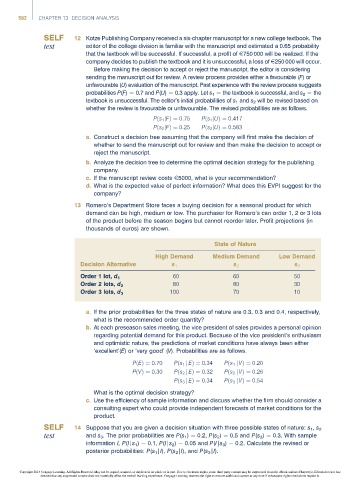
                                13 Romero’s Department Store faces a buying decision for a seasonal product for which
                                    demand can be high, medium or low. The purchaser for Romero’s can order 1, 2 or 3 lots
                                    of the product before the season begins but cannot reorder later. Profit projections (in
                                    thousands of euros) are shown.

                                                                           State of Nature
                                                         High Demand       Medium Demand       Low Demand
                                  Decision Alternative        s 1                s 2                s 3
                                                               60                60                 50
                                  Order 1 lot, d 1
                                                               80                80                 30
                                  Order 2 lots, d 2
                                                              100                70                 10
                                  Order 3 lots, d 3
                                    a. If the prior probabilities for the three states of nature are 0.3, 0.3 and 0.4, respectively,
                                      what is the recommended order quantity?
                                    b. At each preseason sales meeting, the vice president of sales provides a personal opinion
                                      regarding potential demand for this product. Because of the vice president’s enthusiasm
                                      and optimistic nature, the predictions of market conditions have always been either
                                      ‘excellent’(E) or ‘very good’ (V). Probabilities are as follows.
                                                  PðEÞ¼ 0:70   Pðs 1 j EÞ¼ 0:34  Pðs 1 j VÞ¼ 0:20
                                                  PðVÞ¼ 0:30   Pðs 2 j EÞ¼ 0:32  Pðs 2 j VÞ¼ 0:26
                                                               Pðs 3 j EÞ¼ 0:34  Pðs 3 j VÞ¼ 0:54
                                      What is the optimal decision strategy?
                                    c. Use the efficiency of sample information and discuss whether the firm should consider a
                                      consulting expert who could provide independent forecasts of market conditions for the
                                      product.
                                14 Suppose that you are given a decision situation with three possible states of nature: s 1 , s 2
                                    and s 3 . The prior probabilities are P(s 1 ) ¼ 0.2, P(s 2 ) ¼ 0.5 and P(s 3 ) ¼ 0.3. With sample
                                    information I, P(I|s 1 ) ¼ 0.1, P(I|s 2 ) ¼ 0.05 and P(I|s 3 ) ¼ 0.2. Calculate the revised or
                                    posterior probabilities: P(s 1 |I), P(s 2 |I), and P(s 3 |I).


                Copyright 2014 Cengage Learning. All Rights Reserved. May not be copied, scanned, or duplicated, in whole or in part. Due to electronic rights, some third party content may be suppressed from the eBook and/or eChapter(s). Editorial review has
                      deemed that any suppressed content does not materially affect the overall learning experience. Cengage Learning reserves the right to remove additional content at any time if subsequent rights restrictions require it.

