


Page 604 -
P. 604
584   CHAPTER 13 DECISION ANALYSIS


                                17 In Problem 16, if P(s 1 ) ¼ 0.25, P(s 2 ) ¼ 0.50 and P(s 3 ) ¼ 0.25, find a recommended
                                    decision for each of the three decision makers. Note that for the same decision problem,
                                    different utilities can lead to different decisions.
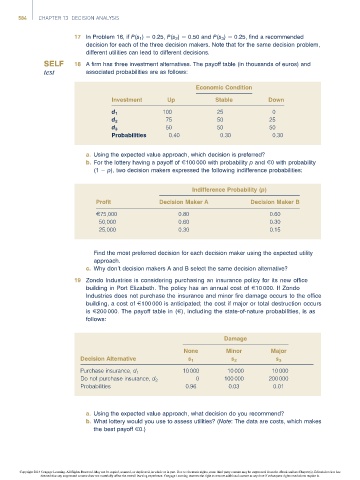
                                18 A firm has three investment alternatives. The payoff table (in thousands of euros) and
                                    associated probabilities are as follows:

                                                                      Economic Condition
                                            Investment       Up             Stable          Down
                                                            100             25               0
                                            d 1
                                            d 2             75              50              25
                                            d 3             50              50              50
                                            Probabilities    0.40            0.30            0.30


                                    a. Using the expected value approach, which decision is preferred?
                                    b. For the lottery having a payoff of E100 000 with probability p and E0 with probability
                                      (1   p), two decision makers expressed the following indifference probabilities:

                                                                     Indifference Probability (p)

                                       Profit             Decision Maker A            Decision Maker B
                                       E75,000                  0.80                        0.60
                                        50,000                  0.60                        0.30
                                        25,000                  0.30                        0.15


                                      Find the most preferred decision for each decision maker using the expected utility
                                      approach.
                                    c. Why don’t decision makers A and B select the same decision alternative?

                                19 Zondo Industries is considering purchasing an insurance policy for its new office
                                    building in Port Elizabeth. The policy has an annual cost of E10 000. If Zondo
                                    Industries does not purchase the insurance and minor fire damage occurs to the office
                                    building, a cost of E100 000 is anticipated; the cost if major or total destruction occurs
                                    is E200 000. The payoff table in (E), including the state-of-nature probabilities, is as
                                    follows:


                                                                              Damage
                                                                  None         Minor         Major
                                  Decision Alternative             s 1           s 2          s 3
                                                                  10 000       10 000        10 000
                                  Purchase insurance, d 1
                                                                      0       100 000       200 000
                                  Do not purchase insurance, d 2
                                  Probabilities                    0.96         0.03         0.01


                                    a. Using the expected value approach, what decision do you recommend?
                                    b. What lottery would you use to assess utilities? (Note: The data are costs, which makes
                                      the best payoff E0.)


                Copyright 2014 Cengage Learning. All Rights Reserved. May not be copied, scanned, or duplicated, in whole or in part. Due to electronic rights, some third party content may be suppressed from the eBook and/or eChapter(s). Editorial review has
                      deemed that any suppressed content does not materially affect the overall learning experience. Cengage Learning reserves the right to remove additional content at any time if subsequent rights restrictions require it.

