


Page 590 -
P. 590
570   CHAPTER 13 DECISION ANALYSIS


                                       The three decision alternatives, denoted by d 1 , d 2 and d 3 , are as follows:
                                                               d 1 ¼ make investment A
                                                               d 2 ¼ make investment B
                                                               d 3 ¼ do not invest
                                     The monetary payoffs associated with the investment opportunities depend largely
                                     on what happens to the real estate market during the next six months. Real estate
                                     prices could go up, remain stable or go down. Thus, the states of nature, denoted by
                                     s 1 , s 2 and s 3 , are as follows:

                                                          s 1 ¼ real estate prices go up
                                                          s 2 ¼ real estate prices remain stable
                                                          s 3 ¼ real estate prices go down
                                     Using the best information available, Swofford estimated the profits or payoffs
                                     associated with each decision alternative and state-of-nature combination. The
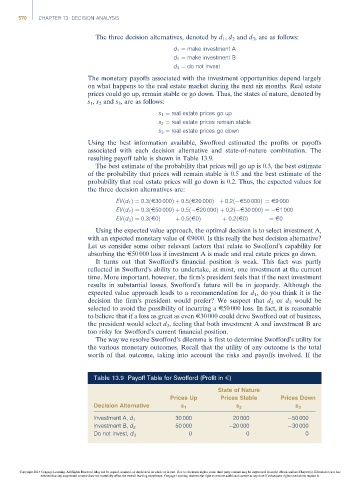
                                     resulting payoff table is shown in Table 13.9.
                                       The best estimate of the probability that prices will go up is 0.3, the best estimate
                                     of the probability that prices will remain stable is 0.5 and the best estimate of the
                                     probability that real estate prices will go down is 0.2. Thus, the expected values for
                                     the three decision alternatives are:

                                             EVðd 1 Þ¼ 0:3ðE30 000Þþ 0:5ðE20 000Þþ 0:2ð E50 000Þ¼ E9 000
                                             EVðd 2 Þ¼ 0:3ðE50 000Þþ 0:5ð E20 000Þþ 0:2ð E30 000Þ¼ E1 000
                                             EVðd 3 Þ¼ 0:3ðE0Þ  þ 0:5ðE0Þ     þ 0:2ðE0Þ     ¼ E0
                                       Using the expected value approach, the optimal decision is to select investment A,
                                     with an expected monetary value of E9000. Is this really the best decision alternative?
                                     Let us consider some other relevant factors that relate to Swofford’s capability for
                                     absorbing the E50000 loss if investment A is made and real estate prices go down.
                                       It turns out that Swofford’s financial position is weak. This fact was partly
                                     reflected in Swofford’s ability to undertake, at most, one investment at the current
                                     time. More important, however, the firm’s president feels that if the next investment
                                     results in substantial losses, Swofford’s future will be in jeopardy. Although the
                                     expected value approach leads to a recommendation for d 1 , do you think it is the
                                     decision the firm’s president would prefer? We suspect that d 2 or d 3 would be
                                     selected to avoid the possibility of incurring a E50 000 loss. In fact, it is reasonable
                                     to believe that if a loss as great as even E30 000 could drive Swofford out of business,
                                     the president would select d 3 , feeling that both investment A and investment B are
                                     too risky for Swofford’s current financial position.
                                       The way we resolve Swofford’s dilemma is first to determine Swofford’s utility for
                                     the various monetary outcomes. Recall that the utility of any outcome is the total
                                     worth of that outcome, taking into account the risks and payoffs involved. If the


                                      Table 13.9 Payoff Table for Swofford (Profit in E)

                                                                            State of Nature
                                                              Prices Up      Prices Stable      Prices Down
                                      Decision Alternative       s 1              s 2               s 3
                                                               30 000            20 000            50 000
                                      Investment A, d 1
                                      Investment B, d 2        50 000            20 000            30 000
                                      Do not invest, d 3            0                0                 0


                Copyright 2014 Cengage Learning. All Rights Reserved. May not be copied, scanned, or duplicated, in whole or in part. Due to electronic rights, some third party content may be suppressed from the eBook and/or eChapter(s). Editorial review has
                      deemed that any suppressed content does not materially affect the overall learning experience. Cengage Learning reserves the right to remove additional content at any time if subsequent rights restrictions require it.

