


Page 592 -
P. 592
572   CHAPTER 13 DECISION ANALYSIS


                                     lottery and the E30000 guaranteed payoff as the risk premium that the president would
                                     be willing to pay to avoid the 5 per cent chance of losing E50000.
                                       To calculate the utility associated with a payoff of  E20 000, we must ask
                                     Swofford’s president to state a preference between a guaranteed  E20 000 payoff
                                     and the opportunity to engage in the following lottery.
                                                Lottery: Swofford obtains a payoff of E50 000 with probability p
                                                      and a payoff of  E50 000 with probabilityð1   pÞ:
                                     Note that it is exactly the same lottery we used to establish the utility of a payoff of
                                     E30 000. In fact, this lottery will be used to establish the utility for any monetary
                                     value in the Swofford payoff table. Using this lottery, then, we must ask the
                                     president to state the value of p that provides an indifference between a guaranteed
                                     payoff of  E20 000 and the lottery. For example, we might begin by asking the
                                     president to choose between a certain loss of E20 000 and the lottery with a payoff
                                     of E50 000 with probability p ¼ 0.90 and a payoff of  E50 000 with probability
                                     (1   p) ¼ 0.10. What answer do you think we would get? Surely, with this high
                                     probability of obtaining a payoff of E50 000, the president would select the lottery.
                                     Next, we might ask if p ¼ 0.85 would result in indifference between the loss of
                                     E20 000 for certain and the lottery. Again, the president might tell us that the lottery
                                     would be preferred. Suppose that we continue in this fashion until we get to
                                     p ¼ 0.55, where we find that with this value of p, the president is indifferent between
                                     the payoff of  E20 000 and the lottery. That is, for any value of p less than 0.55, the
                                     president would rather take a loss of E20 000 for certain than risk the potential loss
                                     of E50 000 with the lottery; for any value of p above 0.55, the president would select
                                     the lottery. Thus, the utility assigned to a payoff of  E20 000 is:

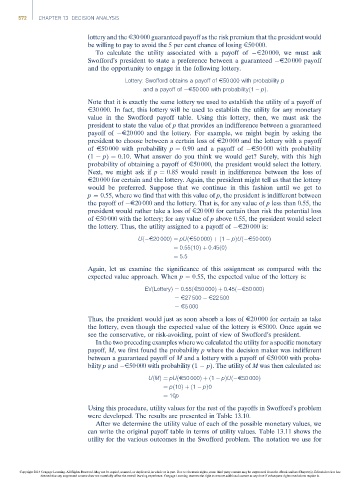
                                                    Uð E20 000Þ¼ pUðE50 000Þþð1   pÞUð E50 000Þ
                                                               ¼ 0:55ð10Þþ 0:45ð0Þ
                                                               ¼ 5:5
                                     Again, let us examine the significance of this assignment as compared with the
                                     expected value approach. When p ¼ 0.55, the expected value of the lottery is:
                                                      EVðLotteryÞ¼ 0:55ðE50 000Þþ 0:45ð E50 000Þ
                                                               ¼ E27 500   E22 500
                                                               ¼ E5 000
                                     Thus, the president would just as soon absorb a loss of E20 000 for certain as take
                                     the lottery, even though the expected value of the lottery is E5000. Once again we
                                     see the conservative, or risk-avoiding, point of view of Swofford’s president.
                                       In the two preceding examples where we calculated the utility for a specific monetary
                                     payoff, M, we first found the probability p where the decision maker was indifferent
                                     between a guaranteed payoff of M and a lottery with a payoff of E50000 with proba-
                                     bility p and  E50000 with probability (1   p). The utility of M was then calculated as:
                                                       UðMÞ¼ pUðE50 000Þþð1   pÞUð E50 000Þ
                                                            ¼ pð10Þþð1   pÞ0
                                                            ¼ 10p
                                     Using this procedure, utility values for the rest of the payoffs in Swofford’s problem
                                     were developed. The results are presented in Table 13.10.
                                       After we determine the utility value of each of the possible monetary values, we
                                     can write the original payoff table in terms of utility values. Table 13.11 shows the
                                     utility for the various outcomes in the Swofford problem. The notation we use for


                Copyright 2014 Cengage Learning. All Rights Reserved. May not be copied, scanned, or duplicated, in whole or in part. Due to electronic rights, some third party content may be suppressed from the eBook and/or eChapter(s). Editorial review has
                      deemed that any suppressed content does not materially affect the overall learning experience. Cengage Learning reserves the right to remove additional content at any time if subsequent rights restrictions require it.

