


Page 588 -
P. 588
568   CHAPTER 13 DECISION ANALYSIS


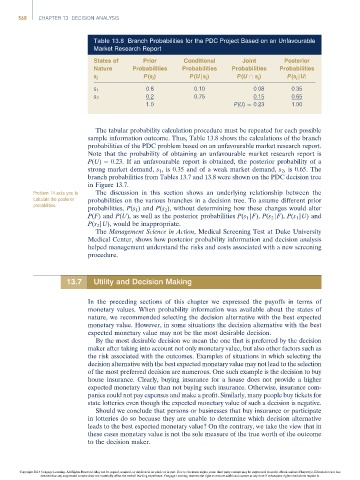
                                      Table 13.8 Branch Probabilities for the PDC Project Based on an Unfavourable
                                      Market Research Report
                                      States of       Prior       Conditional       Joint        Posterior
                                      Nature      Probabilities   Probabilities  Probabilities  Probabilities
                                                      P(s j )       P(U|s j )     P(U \ s j )     P(s j |U)
                                      s j
                                                      0.8            0.10              0.08        0.35
                                      s 1
                                                      0.2            0.75              0.15        0.65
                                      s 2
                                                      1.0                        P(U) ¼ 0.23       1.00


                                       The tabular probability calculation procedure must be repeated for each possible
                                     sample information outcome. Thus, Table 13.8 shows the calculations of the branch
                                     probabilities of the PDC problem based on an unfavourable market research report.
                                     Note that the probability of obtaining an unfavourable market research report is
                                     P(U) ¼ 0.23. If an unfavourable report is obtained, the posterior probability of a
                                     strong market demand, s 1 , is 0.35 and of a weak market demand, s 2 , is 0.65. The
                                     branch probabilities from Tables 13.7 and 13.8 were shown on the PDC decision tree
                                     in Figure 13.7.
                    Problem 14 asks you to  The discussion in this section shows an underlying relationship between the
                    calculate the posterior  probabilities on the various branches in a decision tree. To assume different prior
                    probabilities.
                                     probabilities, P(s 1 ) and P(s 2 ), without determining how these changes would alter
                                     P(F) and P(U), as well as the posterior probabilities P(s 1 |F), P(s 2 |F), P(s 1 |U) and
                                     P(s 2 |U), would be inappropriate.
                                       The Management Science in Action, Medical Screening Test at Duke University
                                     Medical Center, shows how posterior probability information and decision analysis
                                     helped management understand the risks and costs associated with a new screening
                                     procedure.


                              13.7    Utility and Decision Making


                                     In the preceding sections of this chapter we expressed the payoffs in terms of
                                     monetary values. When probability information was available about the states of
                                     nature, we recommended selecting the decision alternative with the best expected
                                     monetary value. However, in some situations the decision alternative with the best
                                     expected monetary value may not be the most desirable decision.
                                       By the most desirable decision we mean the one that is preferred by the decision
                                     maker after taking into account not only monetary value, but also other factors such as
                                     the risk associated with the outcomes. Examples of situations in which selecting the
                                     decision alternative with the best expected monetary value may not lead to the selection
                                     of the most preferred decision are numerous. One such example is the decision to buy
                                     house insurance. Clearly, buying insurance for a house does not provide a higher
                                     expected monetary value than not buying such insurance. Otherwise, insurance com-
                                     panies could not pay expenses and make a profit. Similarly, many people buy tickets for
                                     state lotteries even though the expected monetary value of such a decision is negative.
                                       Should we conclude that persons or businesses that buy insurance or participate
                                     in lotteries do so because they are unable to determine which decision alternative
                                     leads to the best expected monetary value? On the contrary, we take the view that in
                                     these cases monetary value is not the sole measure of the true worth of the outcome
                                     to the decision maker.


                Copyright 2014 Cengage Learning. All Rights Reserved. May not be copied, scanned, or duplicated, in whole or in part. Due to electronic rights, some third party content may be suppressed from the eBook and/or eChapter(s). Editorial review has
                      deemed that any suppressed content does not materially affect the overall learning experience. Cengage Learning reserves the right to remove additional content at any time if subsequent rights restrictions require it.

