


Page 409 - Analog and Digital Filter Design
P. 409
406 Analog and Digital Filter Design


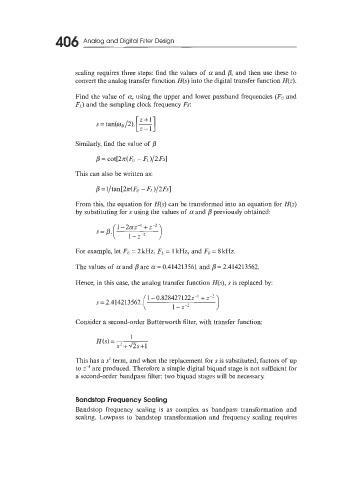
                        scaling requires three steps: find the values of  a and p, and then use these to
                        convert the analog transfer function H(s) into the digital transfer function If(.).

                        Find the value of  a, using the upper and lower passband frequencies (Fu and
                        FL) and the sampling clock frequency Fs:
                              s = tan(mD /2). [ 71
                                            Z+l
                                            I-
                        Similarly, find the value of p

                              p = CO~[~K( Fu  - FL)/2 Fs]

                        This can also be written as:

                              p =l/tan[2n(FL, -FL)/2Fs]

                        From this, the equation for H(s) can be transformed into an equation for H(2)
                        by substituting for s using the values of  a and p previously obtained:


                        For example, let FLi = 2 kHz, FL = 1 kHz, and Fs = 8 kHz.

                        The values of  a and p are a = 0.414213561 and p = 2.414213562.

                        Hence, in this case, the analog transfer function H(s), s is replaced by:

                                              1 - 0.8284271222-' + z-?
                              s = 2.414213562.
                                                      1-  --2
                                                        L.
                        Consider a second-order Butterworth filter, with transfer function:

                                         1
                              H(s) =
                                     sz +&+I

                        This has a S'  term, and when the replacement for s is substituted, factors of up
                        to z4  are produced. Therefore a simple digital biquad stage is not sufficient for
                        a second-order bandpass filter: two biquad stages will be necessary.


                        Bandstop Frequency Scaling
                        Bandstop  frequency  scaling  is  as  complex  as  bandpass  transformation  and
                        scaling. Lowpass to  bandstop  transformation  and frequency scaling requires

