


Page 407 - Analog and Digital Filter Design
P. 407
404 Analog and Digital Filter Design


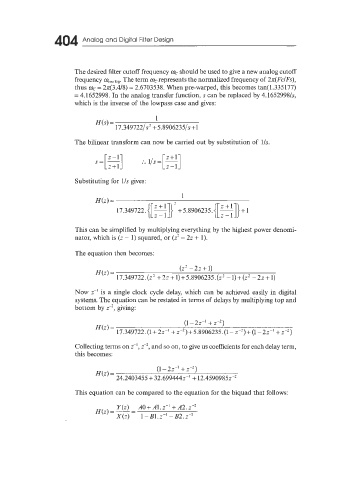
                        The desired filter cutoff frequency wc should be used to give a new analog cutoff
                        frequency wc,,fc,,,, log.  The term wc represents the normalized frequency of 24Fc/Fs),
                        thus wc = 2n(3.4/8) = 2.6703538. When pre-warped, this becomes tan(1.335177)
                        = 4.1652998. In the analog transfer function, s can be replaced by 4.1652998/s,
                        which is the inverse of the lowpass case and gives:

                                                1
                              H(s) =
                                    17.3497221s' +5.8906235/s +1
                        The bilinear transform can now be carried out by substitution of  Us.


                        Substituting for lls gives:
                                                       + 5.8906235. { [ s]}
                              H(z) =                    1
                                     17.349722. {[ "'1}' Z-1              +  1


                        This can be simplified by multiplying everything by the highest power denomi-
                        nator, which is (z - 1) squared, or (z'  - 2,- + 1).

                        The equation then becomes:

                                                        (2'  - 2z + 1)
                              H(z) =
                                     17.349722.(z2 + 22 + 1) +5.8906235.(z2 - 1)+ (z'  -22 + 1)

                        Now  2-l  is  a  single clock cycle delay, which can be  achieved easily in digital
                        systems. The equation can be restated in terms of delays by multiplying top and
                        bottom by z-~, giving:

                                                         (1 - 22-1 + z-2)
                              H(:) =
                                     17.349722.(1+2&  +z-')+5.8906235.(1-~-')+(1-2~-~ +z')
                        Collecting terms on -I, z-~, and so on, to give us coefficients for each delay term,
                        this becomes:

                                                 (1 - 22-1 + Y2)
                              H(z) =
                                    24.2403455 + 32.6994447-I + 12.45909857-'

                        This equation can be compared to the equation for the biquad that follows:

