


Page 410 - Analog and Digital Filter Design
P. 410
IIR Filter Design  407


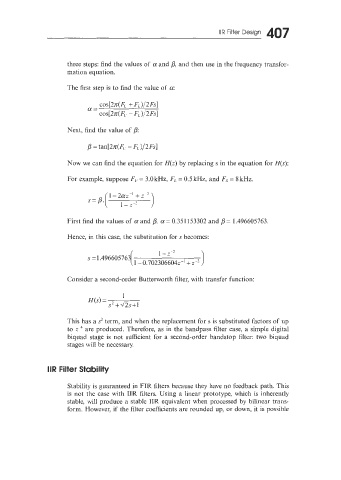
                      three steps: find the values of  a and p, and then use in the frequency transfoor-
                      mation equation.

                      The first step is to find the value of  a:

                               cos[2x(FL + FL)/2Fs]
                            a=
                               COS[~K(I;I~ FL),I'~Fs]
                                        -
                      Next, find the value of @:

                            p = tan[2n(F,. - FL)/2Fs]

                      Now we can find the equation for H(z) by replacing s in the equation for H(s):

                      For example, suppose F,: = 3.0 kHz, FL = 0.5 kHz, and F5 = S kHz.


                      First find the values of  a and p. a = 0.351 153302 and /3  = 1.496605763.

                      Hence, in this case, the substitution for s becomes:

                                                 I-?-'
                            s = 1.496605763
                                                          +
                                          1 - 0.702306604~-~ 2-l
                      Consider a second-order Butterworth filter, with transfer function:


                                      1
                            H(s) =
                                  s2 +as+1
                      This has a s'  term, and when the replacement for s is substituted factors of up
                      to z4  are produced.  Therefore, as in the bandpass filter case, a simple digital
                      biquad  stage is not  sufficient for a  second-order bandstop  filter: two  biquad
                      stages will be necessary.


                Ill? Filter Stability

                      Stability is guaranteed in FIR filters because they have no feedback path. This
                      is not  the  case with  IIR  filters. Using a linear prototype,  which  is inherently
                      stable, will produce  a stable IIR equivalent when  processed by  bilinear trans-
                      form. However, if  the filter coefficients are rounded up, or down, it is possible

