


Page 415 - Analog and Digital Filter Design
P. 415
4 1 2 Analog and Digital Filter Design


                        scaling factor of  1.75 must be used. Rather than scale w before the phase is cal-
                        culated, calculate the phase for a value of  w, then scale the frequency. Essen-
                        tially, the phase shifts indicated above occur at a lower frequency in the case of
                        the normalized 3 dB cutoff response. A 0.249999 rad phase shift will occur at
                        w = 0.2511.75 = 0.143rads.

                        The reader may like to work out the amplitude and phase of higher-order Bessel
                        responses and for this will need to work out Bessel polynomials. Bessel polyno-
                        mials for orders up to three have already been given, in this section and 4th, 5th
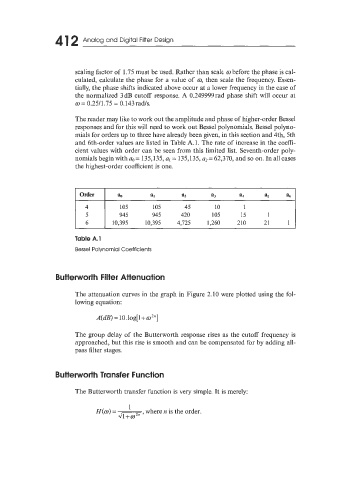
                        and 6th-order values are listed in Table A.l. The rate of  increase in the coeffi-
                        cient values with order can be  seen from this limited list. Seventh-order poly-
                        nomials begin withao= 135,135,  a, = 135,135, a?= 62,370, and so on. In allcases
                        the highest-order coefficient is one.


                           4          105       105      45        10      1
                           5          945       945     420       105      15      1
                           6       10,395    10,395    4,725    1,260    210      21     1

                        Table A.l
                        Bessel Polynomial Coefficients


                  Butterworth Filter Attenuation

                        The attenuation curves in the graph in Figure 2.10 were plotted using the fol-
                        lowing equation:

                              A(&)  = 10.log[l+o'"]

                        The group delay of  the Butterworth response rises as the cutoff frequency is
                        approached, but this rise is smooth and can be compensated for by adding all-
                        pass filter stages.


                  Buiterworth Transfer Function


                        The Butterworth transfer function is very simple. It is merely:

                                        1
                              H(~o)          where n is the order.
                                   =
                                     GiF'

