


Page 419 - Analog and Digital Filter Design
P. 419
4 1 6 Analog and Digital Filter Design


                                      (2R - 1)~
                               aR =sin[   2,~  ]     R = 1,2,3,. . . n

                                                     R = 1,2,3,. . .n
                                   201
                               c, =-
                                   1-6
                                                     R = 2,3,4,. . .n


                  Chebyshev Filter Response

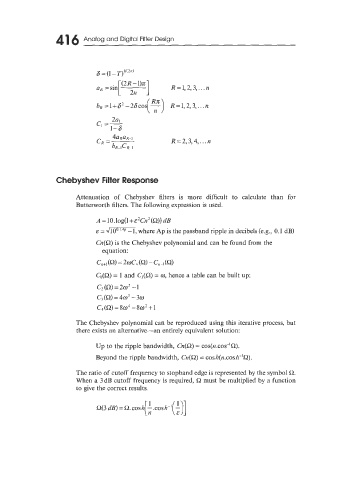
                        Attenuation  of  Chebyshev  filters  is  more  difficult  to  calculate  than  for
                        Butterworth filters. The following expression is used.

                               A = I0.10g(l+E2Ctz2(Q)) dB
                              E = m, Ap is the passband ripple in decibels (e.g., 0.1 dB)
                                           where
                               Cn(Q) is the Chebyshev polynomial and can be found from the
                                equation:

                               c,,,, (Q) = 2WC, (Q) - C,,-I (Q>
                               Co(Q) = 1 and C,(Q) = 0, hence a table can be built up:
                               C2(Q)=2w2 -1
                               c3  (Q) = 403 - 30
                               C,(Q) = 80," -8w' +1

                        The Chebyshev polynomial can be reproduced using this iterative process, but
                        there exists an alternative--an  entirely equivalent solution:

                              Up to the ripple bandwidth, Cn(Q) = cos(uz.cos-~R).

                              Beyond the ripple bandwidth, Ctz(Q) = cos h(n.cosh-'Q).

                        The ratio of cutoff frequency to stopband edge is represented by the symbol Q.
                        When a 3dB cutoff frequency is required, R must be multiplied by a function
                        to give the correct results.

                                                      (31
                               Q(3dB) =Q.cosh -.cosh-l

