


Page 423 - Analog and Digital Filter Design
P. 423
420 Analog and Digital Filter Design


                                              Input                          output

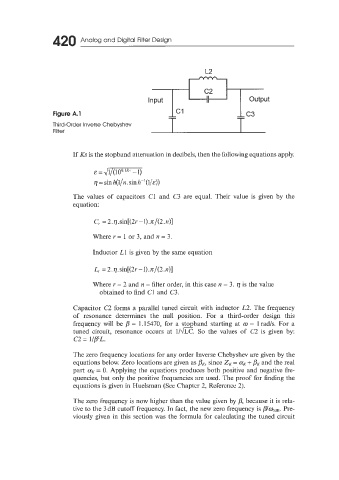
                 Figure A.l
                 Third-Order Inverse Chebyshev
                 Filter


                       If Ks is the stopband attenuation in decibels, then the following equations apply.
                              &=&qpKQ

                              q = sinh(l/rz.sinlz-'(l/&))
                       The  values  of  capacitors  C1  and  C3  are  equal. Their value  is given by  the
                       equation:

                              C,. = 2. q . sin[(2r - 1). n/(2. n)]

                             Where r = 1 or 3, and n = 3.

                             Inductor L1 is given by the same equation


                              L,- = 2. q. sin[(2r - 1).n/(2 A)]
                             Where I'  = 2 and n = filter order, in this case n = 3. q is the value
                               obtained to find C1 and C3.

                       Capacitor  C2 forms a parallel tuned circuit with inductor L2. The frequency
                       of  resonance  determines  the  null  position.  For  a  third-order  design  this
                       frequency will  be p = 1.15470, for  a  stopband  starting at w = 1 rad/s.  For  a
                       tuned  circuit, resonance occurs at  1Im. So the  values  of  C2  is  given  by:
                       c2 = l/P'L.
                       The zero frequency locations for any order Inverse Chebyshev are given by the
                       equations below. Zero locations are given as pK, since 2, = a, + pK and the real
                       part  CC, = 0. Applying the equations produces both positive and negative fre-
                       quencies, but only the positive frequencies are used. The proof for finding the
                       equations is given in Huelsman (See Chapter 2, Reference 2).

                       The zero frequency is now higher than the value given by p, because it is rela-
                       tive to the 3 dB cutoff frequency. In fact, the new zero frequency is p/qde. Pre-
                       viously given in this section was  the formula for calculating the tuned circuit

