


Page 424 - Analog and Digital Filter Design
P. 424
Design Equations  42 1


                      capacitor: C2 = 1/p'L. But the new zero is at p/@dB and the new inductor value
                      is LC&dB.

                                                                       In
                                                                          other
                      So  C2 = @dB'/P2L~;dB. This simplifies to C2 = Q~~/~~L. words, C2 is
                      also multiplied by  @dB-
                                 (2K - 1)n
                             un. =
                                    2 n


                            K= 1, 2,.  . . , n

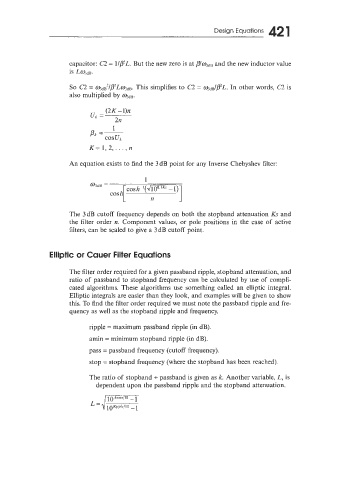
                      An equation exists to find the 3 dB point for any Inverse Chebyshev filter:

                                             1
                             OM5  =
                                   COS 17              1
                                       L                J

                      The 3dB cutoff frequency depends on both the stopband attenuation Ks and
                      the  filter order  n. Component  values, or pole positions in  the case of  active
                      filters, can be scaled to give a 3dB cutoff point.


                Elliptic or Cauer Filter Equations

                      The filter order required for a given passband ripple, stopband attenuation, and
                      ratio of passband  to stopband frequency can be calculated by use of  compli-
                      cated algorithms. These algorithms use  something called an elliptic integral.
                      Elliptic integrals are easier than they look, and examples will be given to show
                      this. To find the filter order required we must note the passband ripple and fre-
                      quency as well as the stopband ripple and frequency.

                            ripple = maximum passband ripple (in dB).

                            amin = minimum stopband ripple (in dB).
                            pass = passband frequency (cutoff frequency).
                            stop = stopband frequency (where the stopband has been reached j.

                            The ratio of stopband + passband is given as k. Another variable, L, is
                              dependent upon the passband ripple and the stopband attenuation.

