


Page 428 - Analog and Digital Filter Design
P. 428
Design Equations  425


                                                       0.153   0.977126
               Table A.4                       0.25    0.243   0.944243
                                                       0.349   0.891423
               Chebyshev Filter Passband
               Power Gain (with 3dB Cutoff)


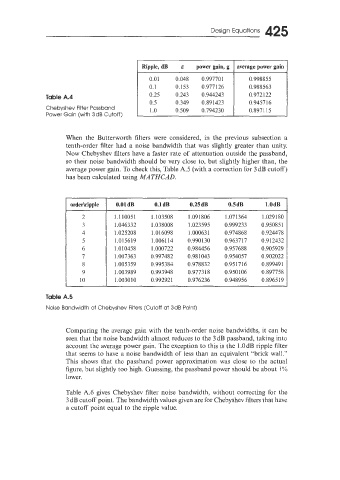
                     When  the  Butterworth  filters were  considered,  in  the  previous  subsection  a
                     tenth-order  filter had  a noise bandwidth  that was  slightly greater than  unity.
                     Now Chebyshev filters have  a faster rate of  attenuation outside the passband,
                     so their noise bandwidth  should be very close to, but slightly higher than, the
                     average power gain. To check this, Table A.5 (with a correction for 3 dB cutoff)
                     has been calculated using MATHCAD.


                       orderhipple   0.01 dB    0.1 dB     0.25 dB     0.5 dB     l.OdB
                          2         1.110051   1.103508   1.09 1806   1.07 I 364   1.029180
                          3         1.046332   1.038008   1.023595    0.999233   0.950851
                          4         1.025208   1.016098   1.00063 1   0.974868   0.924478
                          5         1 .O 15619   1.0061 14   0.990130   0.963717   0.912432
                          6         1.010458   1.000722   0.984456    0.957688   0.905929
                          7         1.007363   0.997482   0.981043    0.9 540 5 7   0.902022
                          8         1.005359   0.995384   0.978832    0.95 17 16   0.89949  1
                          9         1.003989   0.993948   0.9773  18   0.950106   0.897758
                         10         1.003010   0.99292 1   0.976236   0.948956   0.896519

               Table A.5
               Noise Bandwidth of Chebyshev Filters (Cutoff at 3dB Point)


                     Comparing the average gain with the tenth-order noise bandwidths, it can be
                     seen that the noise bandwidth almost reduces to the 3 dB passband, taking into
                     account the average power gain. The exception to this is the 1.0dB ripple filter
                     that seems to have a noise bandwidth  of  less than an equivalent "brick wal!."
                     This  shows that  the  passband  power  approximation  was  close  to  the  actual
                     figure, but slightly too high. Guessing, the passband power should be about 1%
                     lower.

                     Table A.6 gives  Chebyshev filter noise bandwidth,  without  correcting for  the
                     3 dB cutoff point. The bandwidth values given are for Chebyshev filters that have
                     a cutoff point equal to the ripple value.

