


Page 427 - Analog and Digital Filter Design
P. 427
424 Analog and Digital Filter Design


                       As  the filter order increases, the noise equivalent bandwidth approaches the
                       3 dB bandwidth. To find the actual bandwidth, simply multiply the figure given
                       by the 3dB bandwidth of  the filter that you wish to assess.


                       Chebyshev Noise Bandwidth
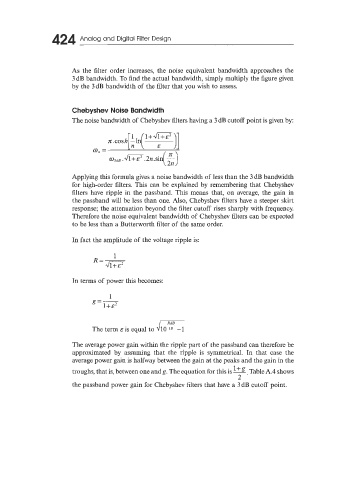
                       The noise bandwidth of Chebyshev filters having a 3 dB cutoff point is given by:


                       Applying this formula gives a noise bandwidth of less than the 3 dB bandwidth
                       for high-order filters. This can be  explained by  remembering that  Chebyshev
                       filters have ripple in the passband. This means that,  on average, the gain in
                       the passband will be less than one. Also, Chebyshev filters have a steeper skirt
                       response; the attenuation beyond the filter cutoff rises sharply with frequency.
                       Therefore the noise equivalent bandwidth of Chebyshev filters can be expected
                       to be less than a Butterworth filter of the same order.

                       In fact the amplitude of  the voltage ripple is:


                       In terms of power this becomes:


                                  1
                             g=-
                                I+&'
                             The term E is equal to dx


                       The average power gain within the ripple part of the passband can therefore be
                       approximated by  assunling  that  the  ripple  is  symmetrical. In  that  case  the
                       average power gain is halfway between the gain at the peaks and the gain in the
                       troughs, that is, between one andg. The equation for this is -.   Table A.4 shows
                                                                         2
                       the passband power gain for Chebyshev filters that have a 3 dB cutoff point.

