


Page 429 - Analog and Digital Filter Design
P. 429
426 Analog and Digital Filter Design


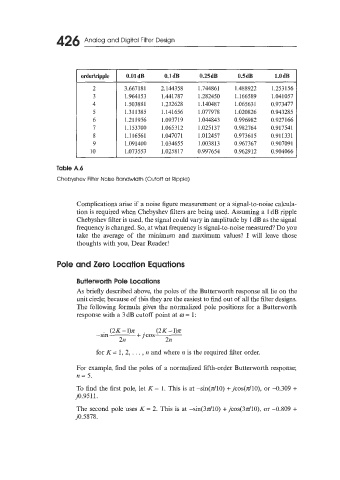
                        I  orderkipple  I   O.OldB   0.ldB    0.25dB      0.5dB      l.OdB

                             2         3.667181   2.144358    1.744861   1.488922   1.253156
                             3         1.964153   1.441787    1.282450   1.166589   1.041057
                             4         1.503881   1.232628    1.140487   1.065631   0.973477
                             5         1.311385   1.141656    1.077978   1.020826   0.943285
                             6         1.211956   1.093719    1.044843   0.996982   0.927166
                             7         1.153700   1.065312    1.025137   0.982764   0.917541
                             8         1.116561   1.047071    1.012457   0.973615   0.911331
                             9         1.091400   1.034655    1.003813   0.967367   0.907091
                             10        1.073553   1.025817   0.997654    0.962912   0.904066


                         Complications arise if  a noise figure measurement or a signal-to-noise calcula-
                        tion is required when Chebyshev filters are being used. Assuming a 1 dB ripple
                        Chebyshev filter is used, the signal could vary in amplitude by  1 dB as the signal
                         frequency is changed. So, at what frequency is signal-to-noise measured? Do you
                        take  the  average of  the  minimum and  maximum values? I  will  leave those
                         thoughts with you, Dear Reader!

                   Pole and Zero  location Equations


                         Butterworth Pole locations
                        As briefly described above, the poles of the Butterworth response all lie on the
                         unit circle; because of this they are the easiest to find out of all the filter designs.
                        The following formula gives the normalized pole positions for a Butterworth
                         response with a 3 dB cutoff point at o = 1:

                                   (2K - 1)7r    (2K -1)~
                              -sin         + jcos
                                     212            2n
                              for K = 1, 2, . . . , n and where n is the required filter order.

                        For example, find the poles of  a normalized fifth-order Butterworth response;
                        n = 5.
                        To find the first pole, let K= 1. This is at -sin(dlO)  +jcos(dlO), or -0.309  +
                        ~0.9511.
                        The second pole uses K= 2. This is at -sin(3d10)  +jcos(3dlO), or -0.809  +
                        j0.5878.

