


Page 425 - Analog and Digital Filter Design
P. 425
422 Analog and Digital Filter Design


                       Now, the required order is equal to 12.  This is given by an equation that uses the
                       two variables k and L:
                                 K(l/k) . K( ,/m)


                               = K(l/L). K(,/iqF)
                       Function K(x) is an elliptic integral of x, so four elliptic integrals are needed to
                       find the filter order. The elliptic integral itself takes the value to be integrated
                       as the starting point. It is a recursive equation. Here are the equations.


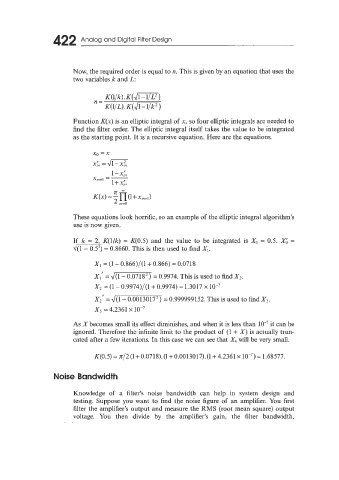
                       These equations look horrific, so an example of the elliptic integral algorithm’s
                       use is now given.

                       If  k  = 2,  K(l/lc) = K(0.5) and  the  value  to  be  integrated  is  Xo = 0.5.  Xi =
                       w) 0.8660. This is then used to find X,.
                                 =
                              Xi = (1 - 0.866)/(1+ 0.866) = 0.0718

                              XI’ = J(1-  0.0718l) = 0.9974. This is used to find Xz.
                              Xz  = (1 - 0.9974)/(1+ 0.9974) = 1.3017 x
                              X2’ = J(1-  0.0013017’)  = 0.999999152. This is used to find 1,.
                              X, = 4.2361 x

                       As X becomes small its effect diminishes, and when it is less than lo-’ it can be
                       ignored. Therefore the infinite limit to the product of  (1 + X) is actually trun-
                       cated after a few iterations. In this case we can see that X, will be very small.

                              K(0.5)= ~/2(1+0.0718).(1+0.0013017).(1+4.2361x  lo-’)=  1.68577.

                  Noise Bandwidth


                       Knowledge  of  a  filter’s  noise  bandwidth  can  help  in  system  design  and
                       testing. Suppose you  want  to find the noise figure of  an amplifier. You  first
                       filter the amplifier’s output and measure the RMS (root mean square) output
                       voltage.  You  then  divide  by  the  amplifier’s  gain,  the  filter  bandwidth,

