


Page 420 - Analog and Digital Filter Design
P. 420
Design Equations  4 1 7


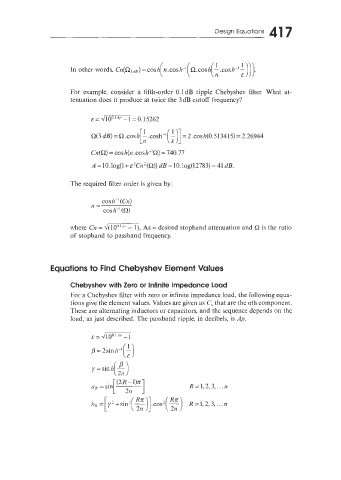
                       In other words, Cn(Q;,ls)=cosh


                       For  example,  consider  a  fifth-order  0.1 dB ripple  Chebyshev  filter. What  at-
                      tenuation does it produce at twice the 3dB cutoff frequency?


                             ~=d10~.'"" =0.15262
                                       -1
                             Q(3 dB)=R.sosh              = 2.~0~h(0.513415)=2.26944

                             Cn(Q) = cosh(iz.cosh-'R) = 740.77

                             A = 10.10g(l+E'C~z2(Q;2)) dB = lO.log(12783) = 41 dB.

                      The required filter order is given by:


                                cos  h-l (Crz)
                             /1 =
                                 cos k-' (Q)
                      where Cn = d( 10"'"  - l), As = desired stopband attenuation and R is the ratio
                       of  stopband to passband frequency.


                 Equations to Find Chebyshev Element Values

                       Chebyshev with Zero or  Infinite Impedance Load
                       For a Chebyshev filter with zero or infinite impedance load, the following equa-
                       tions give the element values. Values are given as C,, that are the nth component.
                       These are alternating inductors or capacitors, and the sequence depends on the
                       load, as just described. The passband ripple, in decibels, is Ap.


                                                           R = 1,2,3,. . . n

