


Page 417 - Analog and Digital Filter Design
P. 417
ri


                  4 1 4 Analog and Digital Filter Design


                        The coefficients are symmetric, so it is only necessary to calculate half the values.

                              a0  = a, = 1
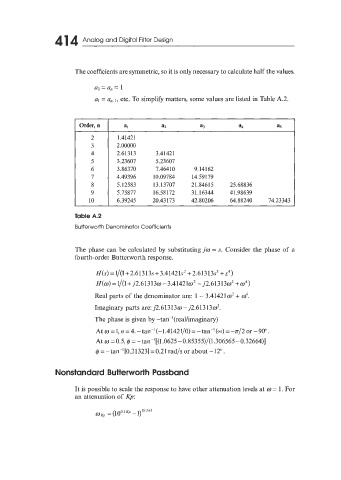
                              al = a,.  I,  etc. To simplify matters, some values are listed in Table A.2.


                                     1.41421
                                     2.00000
                                     2.61313     3.41421
                                     3.23607     5.23607
                                     3.86370     7.464  10   9.14162
                                     4.49396    10.09784    14.59179
                                     5.12583    13.13707    2 1.846 1  5   2 5.6 8 8 3 6
                                     5.75877    16.58172    31.16344   41.98639
                            10       6.39245    20.43173    42.80206   64.88240    74.23343
                        Table A.2

                        Butterworth Denominator Coefficients


                        The phase can be calculated by  substituting jw = s. Consider the phase of  a
                        fourth-order Butterworth response.


                              H(s) = 1/(1+ 2.61 3 13s + 3.41421s' + 2.613 13s3 + s4)
                              H(w) =l/(l+j2.61313w-3.414210'   - j2.613130~ +w4)

                              Real parts of the denominator are: 1 - 3.414210' + id.
                              Imaginary parts are: j2.6 1 3 1 3 w - j2.6 1 3 1 3 w3.
                              The phase is given by -tan-'(real/imaginary)
                              At w =1,n =4.-tan-'(-l.41421/0)=-tan-'(-)=-lr/2or-90".
                              At w =OS, 4 = -tanP[(1.0625-0.85355)/(1.306565-0.32664)]
                              @=-tanP[0.21323]=0.21rad/sor about -12".


                  Nonstandard Butterworth Passband


                        It is possible to scale the response to have other attenuation levels at w = 1. For
                        an attenuation of Kp:

