


Page 416 - Analog and Digital Filter Design
P. 416
Design Equations   41


                       It follows from this that at w= 1, H(w) = 1/4, or 0.7071. This is -3dB  relative
                       to the zero frequency point, no matter what value of  filter order is considered,
                       sinse 1" = 1. For this reason the -3  dB cutoff frequency is considered the natural
                      passband edge. Attenuation for any filter order at other frequencies can be found
                       by substituting different values of  o and PZ.
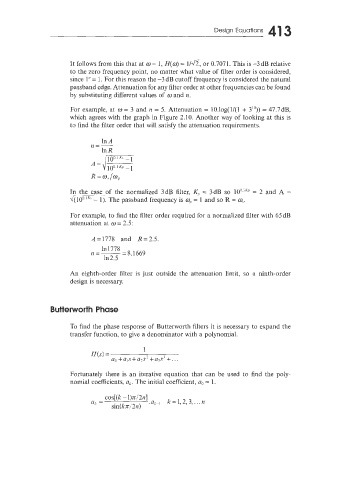
                       For example, at  w = 3 and IZ  = 5. Attenuation = lO.log(l/(l  + 3"))  = 47.7dB,
                      which agrees with the graph in  Figure 2.10. Another way of  looking at this is
                       to find the filter order that will satisfy the attenuation requirements.

                                In A
                             I2 = -
                                In R
                                       -1
                                       -1
                             R=w,/w,,

                       In  the  case  of  the  normalized  3dB filter, K,,  = 3dB so  loo''/'  = 2  and  A  =
                       ~~~
                       d(10"'"'  - 1). The passband frequency is w/, = 1 and so R = w,.
                       For example, to find the filter order required for a normalized filter with 65dB
                      attenuation at w = 2.5:

                             A=1778  and  R=3.5
                                1n1778
                             !I=--    -5.1669
                                 ln2.5
                       An  eighth-order  filter is  just  outside  the  attenuation  limit,  so  a  ninth-order
                      design is necessary.


                 Butterworth Phase

                       To find the phase response of  Butterworth filters it is necessary to expand the
                       transfer function, to give a denominator with a polynomial.

                                             1
                             H(s) =
                                   a(, + a, s + as + cI;s-'  + . . .
                       Fortunately  there  is an iterative equation  that  can be used  to  find  the  poly-
                      nomial coefficients, a,<. The initial coefficient, a.  = 1.

                                 sos[(k - 1)7c/2PZ]
                             a/> =                  k=l,2,3, ... ?I
                                   sin(kn: 2n)

