


Page 422 - Analog and Digital Filter Design
P. 422
Design Equations  419


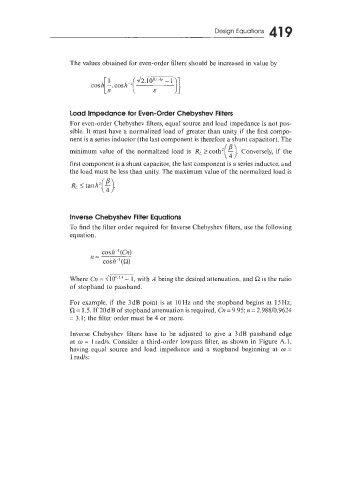
                      The values obtained for even-order filters should be increased in value by


                      Load Impedance for Even-Order Chebyshev Filters
                      For even-order Chebyshev filters, equal source and load impedance is not pos-
                      sible. It must have a normalized load of  greater than unity if  the first compo-
                      nent is a series inductor (the last component is therefore a shunt capacitor). The
                                                                     (3
                      minimum value of  the  normalized  load  is  RL 2~0th~ - . Conversely, if  the
                      first component is a shunt capacitor, the last component is a series inductor. and
                      the load must be less than unity. The maximum value of the normalized load is
                      RL I tanh'i$).


                      Inverse Chebyshev Filter Equations
                      To find the filter order required for Inverse Chebyshev filters, use the following
                      equation.


                      Where Cn = lilo""-1, with A being the desired attenuation, and Q is the ratio
                      of  stopband to passband.

                      For example, if  the 3dB point  is at  lOHz and the stopband begins at  IjMz,
                      Q = 1.5. If 20dB of stopband attenuation is required, Cn = 9.95; n = 2.98810.9624
                      = 3.1; the filter order must be 4 or more.

                      Inverse Chebyshev  filters have  to  be  adjusted  to give a  3dB  passband  edge
                      a.t  w = 1 radls. Consider  a third-order  lowpass filter, as shown in  Figure A.1,
                      having  equal  source  and  load  impedance  and  a  stopband  beginning at  w =
                      1 radls:

