


Page 431 - Analog and Digital Filter Design
P. 431
428 Analog and Digital Filter Design


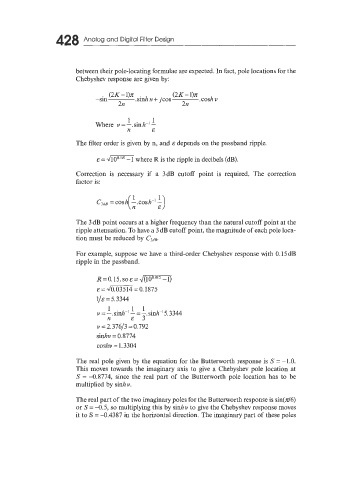
                        between their pole-locating formulae are expected. In fact, pole locations for the
                        Chebyshev response are given by:

                                  (2  K - 1 ) ~       (2 K - 1)~
                              -sin        .sinh n + jcos      .cost4 v
                                     2n                  2n

                                        1.  1
                              Where  v = -.sin  h-' -
                                        n       E
                        The filter order is given by n, and E depends on the passband ripple.


                               E =         where R is the ripple in decibels (dB).
                        Correction  is  necessary  if  a  3dB  cutoff  point  is  required.  The  correction
                        factor is:


                        The 3 dB point occurs at a higher frequency than the natural cutoff point at the
                        ripple attenuation. To have a 3 dB cutoff point, the magnitude of each pole loca-
                        tion must be reduced by  C3dB.

                        For example, suppose we  have a third-order Chebyshev response with 0.15 dB
                        ripple in the passband.

                                          -
                               R =0. 15, SO E = 4

                               E =        = 0.1 875
                               1/~ 5.3344
                                 =
                                  1      1   1
                               v=-.sinli-'-=-.sinli-'5.3344
                                  n      E3
                               v = 2.37613 = 0.792
                               sinhv = 0.8774
                                COS^ = 1.3304

                        The real pole given by  the equation for the Butterworth response is S = -1.0.
                        This moves towards the imaginary axis to give a  Chebyshev pole location at
                        S  = -0.8774,  since the real  part  of  the Butterworth pole location has  to  be
                        multiplied by sinh v.
                        The real part of the two imaginary poles for the Butterworth response is sin(d6)
                        or S = -0.5,  so multiplying this by sinhv to give the Chebyshev response moves
                        it to S = -0.4387  in the horizontal direction. The imaginary part of these poles

