


Page 436 - Analog and Digital Filter Design
P. 436
Design Equations  433


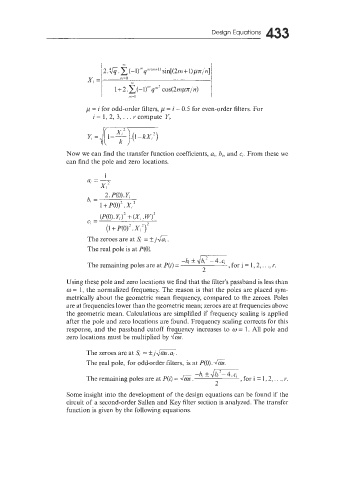
                            x,
                              =


                           p  = i for odd-order iilters, p  = i - 0.5 for even-order filters. For
                             i = 1, 2, 3, . . . I'  compute  1:.


                     Now we can find the transfer function coefficients, a, bj, and ci. From these we
                     can find the pole and zero locations.

                                 1
                            a  =-
                             I  x,2
                                 2.P(O).E:
                            b, =
                                1 + P(0)l . x,
                               (P(O).Y,)' +(X[
                            c, =
                                 (1 + P(0)' . x,
                                            ')?
                            The zeroes are at S, = k j6.
                            The real pole is at P(0).

                                                        -6;  +dbi2 -4.c;
                            The remaining poles are at P(i) =          , for i = 1,2,. . .) P.
                                                               2
                     Using these pole and zero locations we find that the filter's passband is less than
                     w = 1, the normalized frequency. The reason is that the poles are placed sym-
                     metrically about the geometric mean frequency, compared  to the zeroes. Poles
                     are at frequencies lower than the geometric mean; zeroes are at frequencies above
                     the geometric mean. Calculations are simplified if  frequency scaling is applied
                     after the pole and zero locations are found. Frequency scaling corrects for this
                     response, and the passband cutoff  frequency increases to  w = 1. All pole and
                     zero locations must be multiplied by 6.

                           The zeroes are at Sj = +. jJG.
                           The real pole, for odd-order filters, is at P(0). 6.
                                                            -b,  k lib, '- 4. r;
                           The remaining poles are at P(i) = 6.           ,fori=1.:! ,... :T.
                                                                   2
                     Some insight into the development of  the design equations can be found if  the
                     circuit of a second-order Sallen and Key filter section is analyzed. The transfer
                     function is given by the following equations.

