


Page 433 - Analog and Digital Filter Design
P. 433
430 Analog and Digital Filter Design


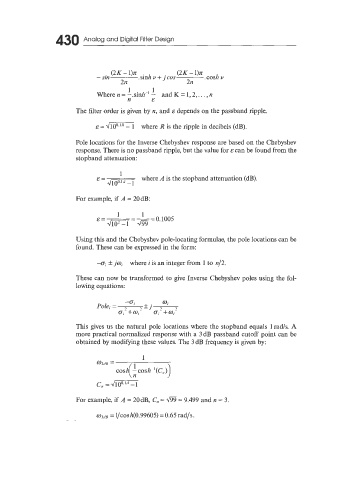
                                   (2K-1)n   .         (2K - 1)n
                               - sin       . Sld1 I/ + J cos   . COSl? u
                                      2n                  211
                                        1.  1
                               Where n = - .smh-' - and K = 1,2, . . . , n
                                        n      E
                        The filter order is given by n, and E depends on the passband ripple.


                              E =  -1       where R is the ripple in decibels (dB).
                        Pole locations for the Inverse Chebyshev response are based on the Chebyshev
                        response. There is no passband ripple, but the value for E can be found from the
                        stopband attenuation:

                                      1
                                  4-        where A is the stopband attenuation (dB).


                        For example, if  A = 20dB:


                                  m-m-
                               E=--   1     1   - 0.1005

                        Using this and the Chebyshev pole-locating formulae, the pole locations can be
                        found. These can be expressed in the form:

                               -0; k jm,  where i is an integer from 1 to n/2.

                        These can now be transformed to give Inverse Chebyshev poles using the fol-
                        lowing equations:


                        This gives us the natural pole locations where the stopband equals lrads. A
                        more practical normalized response with a 3dB passband cutoff point can be
                        obtained by modifying these values. The 3 dB frequency is given by:

                                            1
                               m3dB =
                                     cosh c -cosh-t(C,,))
                               c,, = Jm


                        For example, if A = 20dB, C,, = 4%  = 9.499 and n = 3.

                               m3dB = l/cosh(0.99605) = 0.65 rad/s.

