


Page 434 - Analog and Digital Filter Design
P. 434
43
                                                                  Design Equations


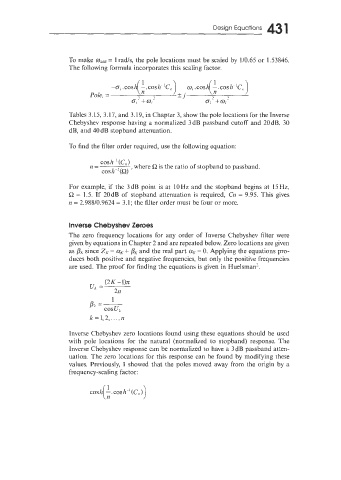
                      To make wjdB = 1 radis, the pole locations must be scaied by  110.65 or 1.53846.
                      The following formula incorporates this scaling factor.

                                           (
                                   -G! .COS17  -.cosh-'C,7   W, .cash  -.cosh-'C,,
                             Pole, =        1:        1 kj        1:
                                         a,? +w,2               6,- +w,-

                      Tables 3.15, 3.17, and 3.19, in Chapter 3, show the pole locations for the Inverse
                      Chebyshev response having a normalized  3 dB passband cutoff  and 20 dB, 30
                      dB, and 40dB stopband attenuation.

                      To find the filter order required, use the following equation:

                                cos  128 (c,z 1
                             12  =       . where C2 is the ratio of stopband to passband.
                                cosh-'(n)  '

                      For example, if  the  3dB point  is  at  lOHz and the stopband begins at  IjHz,
                      L2 = 1.5. If  20dB of  stopband  attenuation is required,  Cn = 9.95. This gives
                      IZ = 2.988/0.9624 = 3.1; the filter order must be four or more.


                      Inverse Chebyshev Zeroes
                      The zero frequency locations  for  any order of  Inverse Chebyshev filter were
                      given by equations in Chapter 2 and are repeated below. Zero locations are given
                      as pn since Z, = aK +   and the real part aK = 0. Applying the equations pro-
                      duces both positive and negative frequencies, but only the positive frequencies
                      are used. The proof  for finding the equations is given in Huelsman'.


                             k = 1,2,. . . , IZ

                      Inverse Chebyshev zero locations found using these equations  should be used
                      with  pole  locations  for  the  natural  (normalized  to  stopband)  response.  The
                      Inverse Chebyshev response can be normalized to have a 3 dB passband  atten-
                      uation. The zero locations for this response can be found by  modifying these
                      values. Previously, I showed that the poles moved away  from the origin by  a
                      frequency-scaling factor:

