


Page 437 - Analog and Digital Filter Design
P. 437
434 Analog and Digital Filter Design


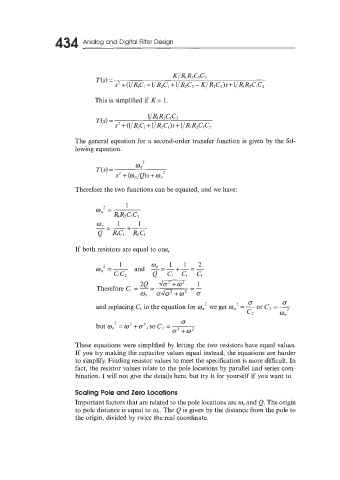
                              This is simplified if K = 1.


                        The general equation for a second-order transfer function is given by the fol-
                        lowing equation.

                                          WL
                              T(s) =
                                               +
                                    s2 + (w,/Q)s on2
                        Therefore the two functions can be equated, and we have:


                        If both resistors are equal to one,


                                            2Q               1
                               Therefore C,  = - =
                                            o,  oJT3=cT
                                                                2        2    0        0
                                                                               or
                              and replacing C, in the equation for a, we get o,, - C2 = 7
                                                                          =
                                                                            C?        w,
                                                        o
                              but o,,’ =w’ +o’,soC~ =-
                                                      o2 +wz
                        These equations were simplified by  letting the two resistors have equal values.
                        If  you try making the capacitor values equal instead, the equations are has-der
                        to simplzy. Finding resistor values to meet the specification is more difficult. In
                        fact, the resistor values relate to the pole locations by parallel and series com-
                        bination. I will not give the details here, but try it for yourself if  you want to.

                        Scaling Pole and Zero locations
                        Important factors that are related to the pole locations are w, and Q. The origin
                        to pole distance is equal to w,. The Q is given by the distance from the pole to
                        the origin, divided by twice the real coordinate.

