


Page 432 - Analog and Digital Filter Design
P. 432
42
                                                                  Design Equations


                      for the Butterworth response is at jcos(d6) or S = kj0.866, so multiplying this
                      by cosh v to give the Chebyshev response moves it to S = fjl ,1522 in the verti-
                      cal direction.

                      The pole locations for a third-order Chebyshev response with 0.15 dB ripple in
                      the passband are:

                            -0.8774
                            -0.4387  f jl. 1522

                      The  Chebyshev  pole  locations  produce  a  normalized  frequency  response
                      with  attenuation  equal to the  ripple  (0.15dR)  at  w = 1. The  3dB point  will
                      have a frequency greater than w = 1. The magnitude of  the pole locations given
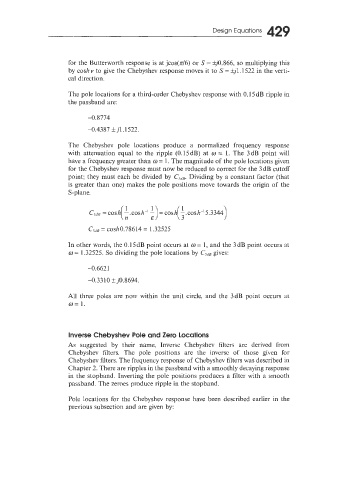
                      for the Chebyshev response must now be reduced to correct for the 3 dB cutoff
                      point;  they must each be divided by  C3dB. Dividing by  a constant factor (that
                      is greater than onej makes the pole positions move towards the origin of  the
                      S-plane.


                            C,,,  = cosh0.78614 = 1.32525

                      In other words, the 0.15 dB point occurs at w = 1, and the 3 dB point occurs at
                      o = 1.32525. So dividing the pole locations by  CJdB gives:

                            -0.662  1

                            -0.33 10 -t. j0.8694.

                      All  three  poles  are  now  within  the  unit  circle,  and  the  3dB point  occurs  at
                      w= 1.


                      Inverse Chebyshev Pole and Zero  Locations
                      As  suggested  by  their  name,  Inverse  Chebyshev  filters  are  derived  from
                      Chebyshev  filters.  The  pole  positions  are  the  inverse  of  those  given  for
                      Chebyshev filters. The frequency response of Chebyshev filters was described in
                      Chapter 2. There are ripples in the passband with a smoothly decaying response
                      in the stopband. Inverting the pole positions produces a filter with  a smooth
                      passband. The zeroes produce ripple in the stopband.

                      Pole  locations for the  Chebyshev response have  been  described earlier in  the
                      previous subsection and are given by:

