


Page 402 - Analog and Digital Filter Design
P. 402
IIR Filter Design   399


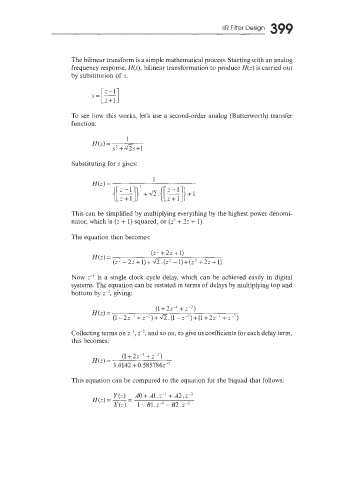
                       The bilinear transform is a simple mathematical process. Starting with an analog
                       frequency response, H(s), bilinear transformation to produce H(z) is carried out
                       by  substitution of  s.


                       To  see how this works, let's use a second-order analog (Butterworth) transfer
                       function:

                                        1
                             H(s) =
                                   s? +.JZs+l
                       Substituting for s gives:


                       This can be simplified by multiplying everything by the highest power denomi-
                       nator. which is (z + 1) squared, or (-1'  i 2z + 1).
                       The equation then becomes:

                                               (z'+2,+Ij
                             H(I) =
                                    (z2 -22+1)+./2.(-.'-1)+(:'+2:+1)

                       Now z-'  is  a  single clock cycle delay.  which  can  be  achieved easily in digital
                       systems. The equation can be restated in terms of delays by multiplying top and
                       bottom by    giving:


                       Collecting terms on z-', -1-'.  and so on, to give us coefficients for each deiay term,
                       this becomes:

                                      (1 + 22-' + z-?)
                             H(z) =
                                    3.4142 + 0.585786z-'

                       This equation can be compared to the equation for the biquad that follows:
                                    Y(;)  AO+Al.z-'+A2.z-'
                             H(z) = -
                                        -
                                        -
                                    X(L)   1-B1.C'  -m.z-'

