


Page 401 - Analog and Digital Filter Design
P. 401
398 Analog and Digital Filter Design


                                                                        ncreasing frequency


                                                                             Zero I  Sampling
                                                               I             Frequency


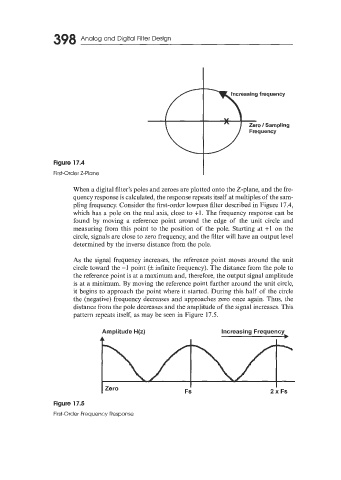
                  Figure 17.4
                  First-Order Z-Plane

                       When a digital filter’s poles and zeroes are plotted onto the Z-plane, and the fre-
                       quency response is calculated, the response repeats itself at multiples of the sam-
                       pling frequency. Consider the first-order lowpass filter described in Figure 17.4,
                       which has a pole on the real axis, close to +l. The frequency response can be
                        found  by  moving a  reference point  around  the edge  of  the  unit  circle  and
                       measuring from this point  to  the position  of  the pole. Starting at +1  on the
                       circle, signals are close to zero frequency, and the filter will have an output level
                        determined by the inverse distance from the pole.

                        As the signal frequency increases, the reference point  moves around the unit
                       circle toward the -1  point (k infinite frequency). The distance from the pole to
                        the reference point is at a maximum and, therefore, the output signal amplitude
                        is at a minimum. By moving the reference point further around the unit circle,
                        it begins to approach the point where it started. During this half  of  the circle
                        the (negative) frequency decreases and approaches zero once again. Thus, the
                        distance from the pole decreases and the amplitude of  the signal increases. This
                       pattern repeats itself, as may be seen in Figure 17.5.

                                Amplitude H(z)                       Increasing Frequency
                                A


                                 Zero
                                                          Fs                        2 x Fs
                  Figure 17.5
                 First-Order Frequency Response

