


Page 396 - Analog and Digital Filter Design
P. 396
Digital FIR Filter Design  393


                      plying M by 2, giving an equation for 2hl; this is exactly what is needed to find
                      N, because N = 2M + 1.


                FIR Filter Coefficient Calculation

                      An example of  how FIR filter coefficients are calculated is shown by  the fol-
                      lowing exercise. Find the coefficients for a bandpass filter (cutoff at wcl and wc->.

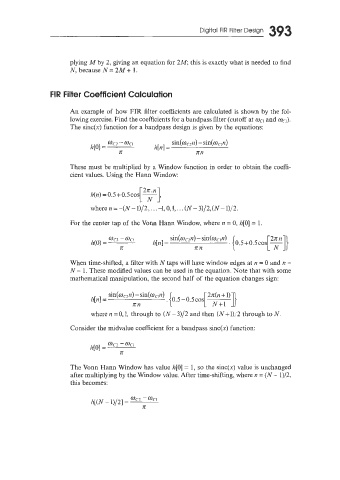
                      The sinc(s) function for a bandpass design is given by the equations:

                                  wc2 - Wl            sin(wc,n) - sin(wcln)
                             h[O] =             h[M] =
                                     2T                      Kn
                      These must be multiplied by  a Window function in order to obtain the coeffi-
                      cient values. Using the Hann Window:


                                             2;n],
                             h(n) =0.5+0.5cos [ -
                             where n = -(iV  - 1)/2:. . . -1,O,l,.  . . (N - 3)/2,(N - 1)/2

                       For the center tap of the Vonn Hann Window. where n = 0, h[O] = 1.

                                  oc2 - WCl
                             h(0) =   a         h[n] = sin(wcln) By1 - sin(mc,n) . ~.5+o.5cos[~]}

                      When time-shifted, a filter with N taps will have window edges at n = 0 and n =
                       N - 1. These modified values can be used in the equation. Note that with some
                      mathematical manipulation, the second half of the equation changes sign:

                                                               [  N+I  1,
                                  sin(wczn)  - sin(oclrz)       27G(n+1)  1
                             h[n] =                 .  0.5-0.5~0~
                                          rcn
                             where n = 0, 1,  through to (N - 3)/2 and then (N + l)/2 through to N.

                       Consider the midvalue coefficient for a bandpass sinc(x) function:


                       The Vonn Hann Window has value h[O] = 1, so the sinc(x) value is unchanged
                       after multiplying by the Window value. After time-shifting, where n = (N- I)i2?
                       this becomes:

                                         wc2 -0ct
                             k[fN - 1)/2] =
                                             r

