


Page 393 - Analog and Digital Filter Design
P. 393
390  Analog and Digital Filter Design


                        The Kaiser-Bessel window, with a = 3.0, produces a first side-lobe attenuation
                        of 70dB. The coefficients are veiy similar to those of  the four-term Blackman-
                        Harris window:
                              h(n) = 0.40243+0.49804c0s[ -1 2a n  +o.09831cos[ 4
                                                                       2a.
                                                                          2n
                                                       N
                                   + o.oo122cos[T] 2n. 3n

                              where n = -(N  - 1)/2,. . . ,-l,O,l,  . . . ,(N - 1)/2.

                        Once again, when time-shifted, the second and fourth terms change sign:

                                                      2a.n
                              Iz(n> = o.40243-o.49804cos[l,]+o.09831cos[~] 2n.2n
                                               2a.
                                   - o.oo122cos[~]
                                                  3n
                              where n = 0,1, . . . , (N - 1)/2.

                        Summary of Fixed FIR Windows
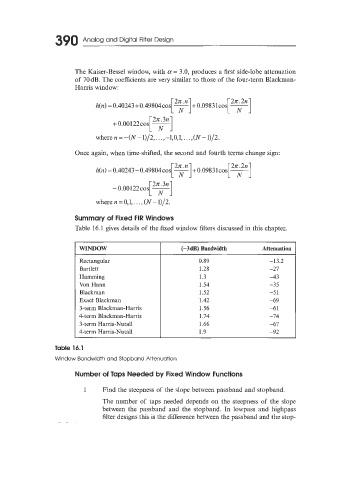
                        Table 16.1 gives details of the fixed window filters discussed in this chapter.


                         WINDOW                         (-3dB)  Bandwidth        Attenuation

                         Rectangular                         0.89                  -13.2
                         Bartlett                            1.28                  -27
                         Hamming                             1.3                   -43
                         Von Hann                            1.54                  -35
                         Blackman                            1.52                  -5  1
                         Exact Blackman                      1.42                  -69
                         3-term Blackman-Harris              1.56                  -6  1
                         4-term Blackman-Harris              1.74                  -74
                         3-term Harris-Nutall                1.66                  -67
                         4-term Harris-Nutall                1.9                   -92

                  Table 16.1
                  Window Bandwidth and Stopband Attenuation

                        Number of Taps Needed by Fixed Window Functions

                          1     Find the steepness of  the slope between passband and stopband.
                                The number of  taps needed depends on the steepness of  the  slope
                                between the  passband  and  the  stopband. In lowpass and highpass
                                filter designs this is the difference between the passband and the stop-

