


Page 391 - Analog and Digital Filter Design
P. 391
388 Analog and Digital Filter Design


                        used by Blackman. Using the Exact Blackman coefficients given, the first side-
                        lobe is attenuated by 69 dB. However, higher-frequency side-lobes have an ampli-
                        tude above this level, so a stopband attenuation of  about 65dB is achieved at
                        the seventh side-lobe. The attenuation then increases at higher frequencies.

                        Exact  Blackman  coefficients do not  produce zero-valued coefficients at  the
                        window edges. It is not necessary to add 1 to the value of n and N. The value
                        of the window edge coefficient is very small, though: h(0) = 0.00687876.

                        6  Blackman-Harris Window
                        Harris improved the stopband attenuation of the Blackman window by adjust-
                        ing  the  values  slightly  for  the  three-term  cosine  series.  The  first  side-lobe
                        attenuation produced by the three-term series coefficients is 61 dB. At higher fre-
                        quencies the attenuation is greater.

                        Harris also produced a four-term series that gave even better stopband attenu-
                        ation. The four-term series has a first side-lobe attenuation of  74dB.


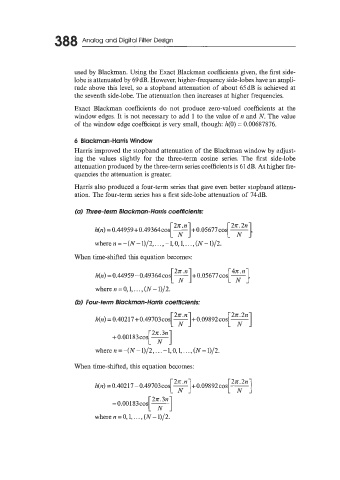
                        (a) Three-tern Blackman-Hams Coefficients:
                                                                       2n 2n
                                                      2n
                              h(n) = 0.44959+0.49364cos[~]+O.O5677cos[-],
                                                         n
                              wheren=-(N-1)/2  ,..., -l,O,l,...,  (N-l)/2.
                        When time-shifted this equation becomes:

                                                                       4K  11
                                                      2n
                                                         n
                              h(n> = 0.44959-0.49364cos[~]+0.05677cos[-+],
                              where n = 0, 1, . . . , (N - 1)/2.
                        (b) Four-tern Blackmun-Hums Coefficients:


                              where n = -(N-  1)/2,. . . -l,O,  1,. . ., (N- 1)/2.

                        When time-shifted, this equation becomes:

                                                         n
                                           o.49703cos[~]+o.09892cos[~]
                                                                       2n.2n
                                                      2~
                              h(n) = 0.40217 -
                                   -0.00183cos[~] 2~.
                                                  3n
                              wheren=O,l,..-, (N-l)/2.

