


Page 392 - Analog and Digital Filter Design
P. 392
Digital FIR Filter Design  389


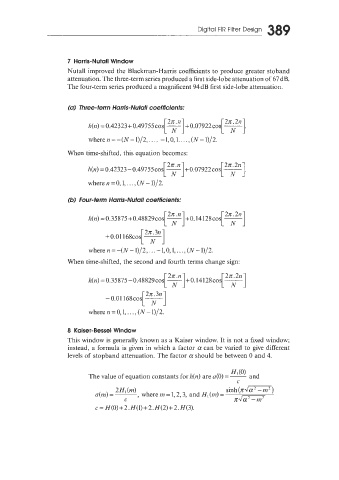
                      7  Harris-Nutall Window
                      Nutall improved the BIackman-Harris coefficients to produce greater  stoband
                      attenuation. The three-term series produced a first side-lobe attenuation of 67 d
                      The four-term series produced a magnificent 94dB first side-lobe attenuation.


                      (a) Three-term Harris-Nutall coefficients:
                                                                     2n. 212
                                                    2n
                            bin) = o.42323+o.49755cos[-j+o.o7922cos[~].
                                                       i?
                                                     N
                            where n = -(N - 1)/2>. . . , - 1,0,1.. . . , (N - 1)/2~
                      When time-shifted, this equation becomes:
                                                    2n.n
                                         o.49755cos[--]+o.07922cos   -
                                                                     2n. 2n 7
                            h(n) = 0.42323 -                        [  A'   ' J
                            where n = 0,1,  . . , (N - 1)/2.
                                        ~
                      (b) Four-term Harris- Nutall coefficients:


                            /7(n) = 0.35875 +0.48829cos[7]+0.  1412t3cos[T] 2n.2n
                                                    2n.n
                                 + 0.0 1168cos[ 2n. 3n


                            where n= -(N-  1)/2, I.. -1,O,  1,. . ~, (N- 1)/2.
                      When time-shifted, the second and fourth terms change sign:

                                                                     2n.
                            h(n) = 0.35875 -0.48829cos[---]+o.  2n.n   14128co~[~]
                                                                         2n
                                                     N
                                 - 0.01 168cos[T] 2n.3n
                            where n = 0,1,  . . . , (N - 1)/2.


                      8 Kaiser-Bessel Window
                      This window is generally known as a Kaiser window. It is not a hed window;
                      instead, a formula is given in which a factor a can be varied  to give different
                      levels of  stopband attenuation. The factor a should be between 0 and 4.

                                                                       Hi@) and
                            The value of equation constants for h(n) are n(0) = -
                                                                         C
                                                                      sinh(nd252)
                              n(m) = 2H1(m', where 112 = 1,2,3, and H,(m) =
                                       c                                nJiiT2
                                    ~
                              c = H(0) + 2. H(l) + 2 .H(2) + 2 .H(3).

