


Page 390 - Analog and Digital Filter Design
P. 390
Digital FIR Filter Design  387


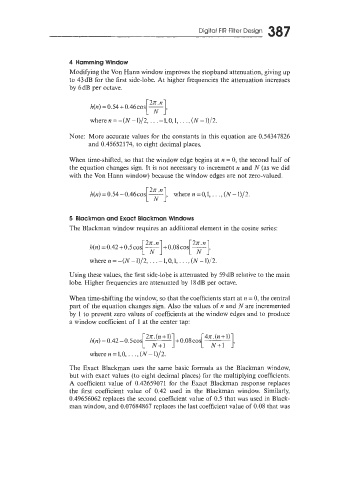
                      4  Hamming Window
                      Modifying the Von Hann window improves the stopband attenuation, giving up
                      to 43 dB for the first side-lobe. At higher frequencies the attenuation increases
                      by 6dB per octave.


                             h(a) = 0.54 + 0.46~0~
                             where n = -(N - 1)/2, . . . - 1,0,1, . . . ~  (N - 1)!2.

                      Note:  More accurate values for the constants in this equation are 0.54347826
                            and 0.45652174, to eight decimal places.

                      When time-shifted, so that the window edge begins at n = 0, the second half of
                      the equation changes sign. It is not necessary to increment n and N (as we did
                      with the Von Hann window) because the window edges are not zero-valued.

                             ~(Fz) 0.54-0.46~0~ [2;n], - wheren=O,l,. . .,(N--1)/2.
                                =


                      5  Blackman and Exact Blackman Windows
                      The Blackman window requires an additional element in the cosine series:

                                              2n.n
                            h(n) = 0.42+0.5 cosL]+0.08  cos[N], 2n. rt
                                             LN
                            where n = -(N - 1)/2, . . . - 1,0,1, . . . (N - l)/2.
                                                           ~
                      Using these values, the first side-lobe is attenuated by 59dB relative to the main
                      lobe. Higher frequencies are attenuated by  18 dB per octave.

                      When time-shifting the window, so that the coefficients start at n = 0, the central
                      part of the equation changes sign. Also the values of n and N are incremented
                      by  1 to prevent zero values of coefficients at the window edges and to produce
                      a window coefficient of  1 at the center tap:


                             where n = 1,0, . . . , (N - 1)/2.
                      The Exact Blackman uses the same basic formula as the  Blackman window,
                      but with exact values (to eight decimal places) for the multiplying coefficients.
                      A coefficient value of  0.42659071 for the  Exact  Blackman response replaces
                      the  first coefficient  value  of  0.42  used  in  the  Blackman window.  Similarly,
                      0.49656062 replaces the second coefficient value of 0.5  that was used in Black-
                      man window, and 0.07684867 replaces the last coefficient value of 0.08 that was

