


Page 394 - Analog and Digital Filter Design
P. 394
Digital FIR Filter Design   39


                              band frequencies. In bandpass and bandstop filter designs there are
                              two slopes, one on either side of  the passband or stopband. In these
                              designs the smaller of  the two values (the steepest slope) should be
                              chosen.
                        2     Find the filter ratio.
                              Using the value of the slope obtained by the method outlined above,
                              a  ratio  can  be  obtained.  This  ratio  is  dependent  on  whether  the
                              response  is  lowpass,  highpass,  bandpass,  or  bandstop.  The  ratio
                              required for all filters to determine the number of taps is:
                               ratio = (clock frequency - slope)/slope.
                        3     Decide on the window.

                              The number of taps required also depends upon the window function
                              used.  A  rectangular window requires the  least  number of  taps.  In
                              order  of  increasing number  of  taps  required  we  have:  Von  Hann
                              (or  Hanning), Hamming,  Bartlett  (triangular  window), and  finally
                              Blackman.
                        4     Calculate the number of  taps.
                              The number of  taps required for a rectangular window is:
                              N  = 1 + (integer) 0.95 x ratio.
                              For example, if  the clock frequency is 1 kHz and the filter cutoff fre-
                              quency is 80 Hz, the ratio = (1000 - 80)/80 = 11.5, then 0.95 x 11.5 =
                              10.925. The ratio equals (integer) 10
                              N= 1 + 10= 11.
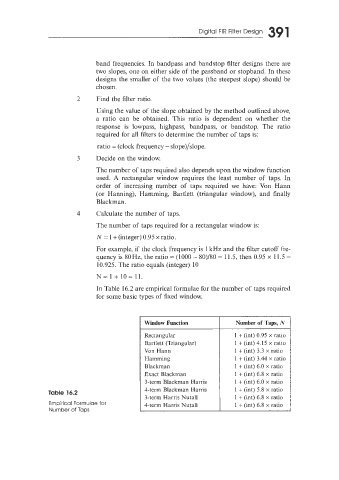
                              In Table 16.2 are empirical formulae for the number of taps required
                              for some basic types of fixed window.


                                             Window Function
                                             Rectangular
                                             Bartlett (Triangular)      1 i (int) 4.15 x ratio
                                             Von Hann                   1 i (int) 3.3 x ratio   I
                                             Hamming                    1 + (int) 3.44 x ratio  I
                                             Blackman                   1 + (int) 6.0 x ratio  1
                                             Exact Blackman             1 + (int) 6.8 x ratio   1  1
                                             3-term Blackman Harris     1 + (int) 6.0 x ratio  1
                  ble 16.2                   I-term Blackman Harris     1 + (inti 5.8 x ratio  1
                                             3-term Harris Nutall       I + (int) 6.8 x ratio  1
                Empirical Formulae for       I-term Harris Nutall       1 + (int) 6.8 x ratio  1
                Number of Taps

