


Page 400 - Analog and Digital Filter Design
P. 400
397
                                                                     liR Filter Design


                 Bilinear Transformation

                       The bilinear transform is used to convert the analog frequency response into a
                       digital domain response. The advantage of  the bilinear transform is that  any
                       response, be it lowpass, highpass, bandpass, or bandstop. can be converted. The
                       digital domain is also known as the 2-domain.

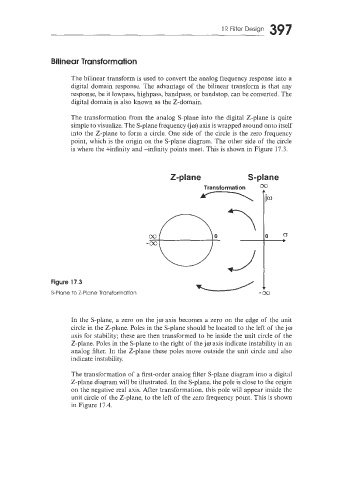
                       The transformation  from the analog S-plane into the digital Z-plane is quite
                       simple to visualize. The S-plane frequency Qw) axis is wrapped around onto itself
                       into the Z-plane to form a circle. One side of  the circle is the zero frequency
                       point, which is the origin on the S-plane diagram. The other side of  the circle
                       is where the +infinity and -infinity  points meet. Thls is shown in Figure 17.3.


                                                     Z-plane                 S-plane
                                                               Transformation   O0
                                                              T


                 Figure 17.3
                 S-Plane to Z-Plane Transformation


                       In the §-plane, a zero on the jw axis becomes a zero on the edge of  the  anit
                       circle in the Z-plane. Poles in the S-plane should be located to the left of the jw
                       axis for stability; these are then transformed to be inside the unit circle of  the
                       Z-plane. Poles in the S-plane to the right of  the jw axis indicate instability in an
                       analog filter. In the Z-plane these poles move outside the unit circle and also
                       indicate instability.
                       The transformation of  a first-order analog filter S-plane diagram into a digital
                       Z-plane diagram will be illustrated. In the S-plane, the pole is close to the origin
                       on the negative real axis. After transformation, tkis pole will appear inside the
                       unit circle of  the Z-plane, to the left of the zero frequency point. This is shown
                       in Figure 17.4.

