


Page 336 - Applied Process Design For Chemical And Petrochemical Plants Volume III
P. 336
66131_Ludwig_CH11A  5/30/2001 4:49 PM  Page 295


                                                                Refrigeration Systems                                      295

                     erence and the percentage change in tonnage noted for   Units are usually operated with 50—200 psig steam,
                     change in water-off temperature. A unit producing 100 tons  although pressures down to 2 psig are possible, and 30 psig
                     at 50°F chilled water will also produce 115 tons when the  units are giving economical performance for their specific
                     chilled water is used at 55°F or will produce only 70 tons  situation.
                     when the chilled water off the unit is 40°F.            In transporting this water through insulated pipes to the
                       The thermal efficiency of the units is approximately:  process equipment, it is good practice to allow a 2°F tem-
                                                                           perature rise when planning heat transfer calculations.
                     Operating Steam Pressure, psig  Thermal Efficiency, %   Cooling water must be specified at maximum expected
                                                                           temperature, otherwise the unit cannot condense in hot
                                 15                       30
                                                                           weather and still maintain full load.
                                100                       60
                                400                       80
                                                                           Utilities
                     Operation
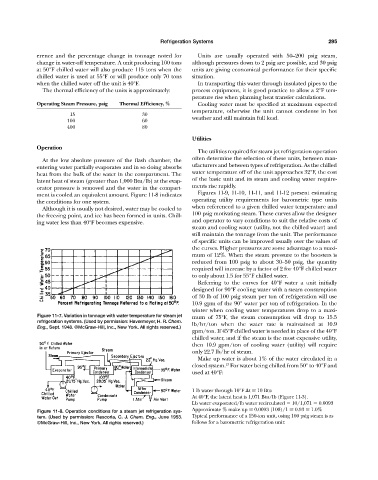
                                                                             The utilities required for steam jet refrigeration operation
                                                                           often determine the selection of these units, between man-
                       At the low absolute pressure of the flash chamber, the
                                                                           ufacturers and between types of refrigeration. As the chilled
                     entering water partially evaporates and in so doing absorbs
                                                                           water temperature off of the unit approaches 32°F, the cost
                     heat from the bulk of the water in the compartment. The
                                                                           of the basic unit and its steam and cooling water require-
                     latent heat of steam (greater than 1,000 Btu/lb) at the evap-
                                                                           ments rise rapidly.
                     orator pressure is removed and the water in the compart-
                                                                             Figures 11-9, 11-10, 11-11, and 11-12 present estimating
                     ment is cooled an equivalent amount. Figure 11-8 indicates
                                                                           operating utility requirements for barometric type units
                     the conditions for one system.
                                                                           when referenced to a given chilled water temperature and
                       Although it is usually not desired, water may be cooled to
                                                                           100 psig motivating steam. These curves allow the designer
                     the freezing point, and ice has been formed in units. Chill-
                                                                           and operator to vary conditions to suit the relative costs of
                     ing water less than 40°F becomes expensive.
                                                                           steam and cooling water (utility, not the chilled water) and
                                                                           still maintain the tonnage from the unit. The performance
                                                                           of specific units can be improved usually over the values of
                                                                           the curves. Higher pressures are some advantage to a maxi-
                                                                           mum of 12%. When the steam pressure to the boosters is
                                                                           reduced from 100 psig to about 30—50 psig, the quantity
                                                                           required will increase by a factor of 2 for 40°F chilled water
                                                                           to only about 1.5 for 55°F chilled water.
                                                                             Referring to the curves for 40°F water a unit initially
                                                                           designed for 90°F cooling water with a steam consumption
                                                                           of 30 lb of 100 psig steam per ton of refrigeration will use
                                                                           10.9 gpm of the 90° water per ton of refrigeration. In the
                                                                           winter when cooling water temperatures drop to a maxi-
                     Figure 11-7. Variation in tonnage with water temperature for steam jet  mum of 75°F, the steam consumption will drop to 15.5
                     refrigeration systems. (Used by permission: Havermeyer, H. R. Chem.  lb/hr/ton when the water rate is maintained at 10.9
                     Eng., Sept. 1948. ©McGraw-Hill, Inc., New York. All rights reserved.)
                                                                           gpm/ton. If 45°F chilled water is needed in place of the 40°F
                                                                           chilled water, and if the steam is the most expensive utility,
                                                                           then 10.9 gpm/ton of cooling water (utility) will require
                                                                           only 22.7 lb/hr of steam.
                                                                             Make up water is about 1% of the water circulated in a
                                                                                       13
                                                                           closed system. For water being chilled from 50° to 40°F and
                                                                           used at 40°F:


                                                                           1 lb water through 10°F  t   10 Btu
                                                                           At 40°F, the latent heat is 1,071 Btu/lb (Figure 11-3).
                                                                           Lb water evaporated/lb water recirculated   10/1,071   0.0093
                     Figure 11-8. Operation conditions for a steam jet refrigeration sys-  Approximate % make up   0.0093 (100)/1   0.93   1.0%
                     tem. (Used by permission: Rescorla, C. J. Chem. Eng., June 1953.  Typical performance of a 150-ton unit, using 100 psig steam is as
                     ©McGraw-Hill, Inc., New York. All rights reserved.)   follows for a barometric refrigeration unit:

