


Page 332 - Applied Process Design For Chemical And Petrochemical Plants Volume III
P. 332
66131_Ludwig_CH11A  5/30/2001 4:49 PM  Page 291


                                                                Refrigeration Systems                                      291

                                                                             7. Steam condensate can be recovered in surface type
                                                                               units.
                                                                             8. Refrigeration tonnage can be varied as to amount and
                                                                               temperature level.
                                                                             9. Start up and operation are simple.
                                                                            10. Barometric units can use dirty, brackish, or waste water.
                                                                            11. Cost per ton of refrigeration is relatively low.

                                                                           Materials of Construction

                                                                             The main fabricated parts of the units are carbon steel, with
                                                                           suitable corrosion allowance for the conditions of the chilled
                                                                           and condensing water. When brackish or sea water is used
                                                                                                                      1
                                                                           in a barometric condenser, steel construction with a  / 4 -in. to
                                                                           3 / 8 -in. corrosion allowance is suggested, and minimum wall
                                                                                   1
                                                                                            3
                                                                           plates of  / 2 -in. to  / 4 -in. may be justified. Internal splash
                                                                                          1
                                                                                                   3
                                                                           plates should be  / 2 -in. to  / 4 -in. minimum, because the
                                                                           atmosphere of water vapor-air is very corrosive. Alloy con-
                                                                           struction is not justified except in exceptional cases.
                                                                             For surface condensers, the tubes, tubesheets, and shell
                                                                           should be consistent with experiences in heat exchanger
                                                                           construction. In sea or brackish water, one of the cupro-
                                                                           nickels or aluminum brass may be a good choice for tubes.
                                                                           The water boxes may be vertically divided to allow half of
                                                                           the unit to operate while the other half is being opened for
                                                                           repair or inspection.
                                                                             The booster ejectors are usually of steel plate (or cast)
                                                                           with Monel steam nozzles.
                                                                             The air ejectors are usually of cast iron with Monel noz-
                                                                           zles. The associated inter- and after-condensers are usually of
                                                                           cast iron shell and water boxes with Admiralty tubes (unless
                                                                           sea or brackish water) with Muntz metal tubesheets. Some
                                                                           inter- and after-condensers may also be barometric rather
                                                                           than tubular.
                                                                             These units usually come complete with interconnecting
                                                                           piping, valves, strainers, control valves, level controls, gages,
                                                                           water pumps, etc. The specifications should state how much
                                                                           of this is desired by the purchaser, as well as delineating each
                                                                           detail peculiar to the system, such as the use of sea or brack-
                                                                           ish water, special materials of construction for condenser
                                                                           water, steam, chilled water, etc.
                                                                             The dimensions of Figure 11-4 for barometric-type units
                                                                           and Figure 11-5 for surface-type units are a general guide as
                                                                           to space requirements.


                                                                           Performance

                                                                             The two basic types of steam jet units as shown in Figure
                                                                           11-6 are
                                                                             • Recirculated water
                                                                             • Once-through water

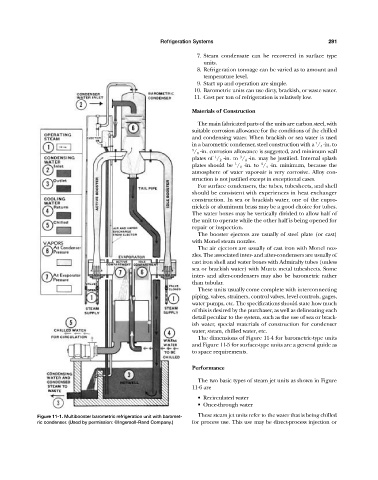
                     Figure 11-1. Multibooster barometric refrigeration unit with baromet-  These steam jet units refer to the water that is being chilled
                     ric condenser. (Used by permission: ©Ingersoll-Rand Company.)  for process use. This use may be direct-process injection or

